My eldest child just turned 17. Born during Pride weekend, and via emergency C-section, this kiddo who made me a mother also initiated me into a new life and path as a woman, therapist, and mystic in general.
I had other plans with how they would come into the world. I had really wanted a home birth and thought i did everything i could to manifest it. It was this birth that taught me how little i was in control of this process, even if it was via my body. My body became the vessel and portal for my child to emerge. I spoke about it in a very early journal article here, if you want more of a summary of the birth story.
Little did i know then that my newborn babe, whose birth was supported by medical intervention and surgery, would also rely on modern medicine to become more of themselves years later. If being born on Pride Sunday (while the medical team shared their Pride festivities’ plans no less) was an oracular hint at all, it comes to no surprise that my kiddo is once again relying on medicine to become fully herself. They also like to be on time and have a singular focus, coming home to themselves as the Cancer Sun they are.
It all makes so much more sense now.
In my studies about menstrual rites of passage called Blood Rites, i have learned from Jane Hardwicke Collings that how we are born sets the stage for how we move through the world and how we make decisions. When we are initiated by menarche, it creates a blueprint for how we care for ourselves and listen to our body’s wisdom. Our first sexual experiences pave the way for how we view sex and our own pleasure. Each blood rite is a stage of the spiral called life and sets the stage for the next iteration.
Our Blood Rites:
1) Birth is the model of who we become
Be it a home birth, free birth, supported by midwives or a c-section, they all are an initiatory portal that paves the way
2) Menarche
We know that our menstrual cycle is a vital sign for our overall health. But did you know that how it is received and honoured is also a key part of the iniation?
3) Sexual awakening and Eventual Union
Initiation of sexual experience is our sex code. For instance, even in a consensual experience, did we learn to centre his pleasure. This can have a hold on our embodiment of love moving forward.
4) Conception and Birth
The conception and birth of our own children also play a role in our story, namely how we experience postpartum connects to our own birth story as we as sets the course for our child’s journey through life.
5)Menopause
The way in which we navigate menopause is a testament to our earlier blood rites. It is also a reflection of the trauma we may have endured earlier in our life and did not heal.
No pressure. And also, thank-you for this map that was unfolding all along. The linear path of life we were taught never made sense to me. I’m so grateful for the reframe of a spiral instead. It was hidden in plain site but needed me to unseen the lies that were repeated until they felt like truth. In her informative article called From Womb to Tomb, Jasmine Alicia Carter unpacks these stages more.
I like this reframe from a popular book – “the body keeps the lore.” It’s not just that the body holds memories or keeps the score of what happened, but also our body is the site of our own mytho-poetic saga.
I shared recently the story of Vasalisa and Baba Yaga. In that folktale, we see how Vasalisa has to learn to trust herself in order to be fully initiated by the rite of passage of becoming her Self. Maybe Baba Yaga was a real human. Maybe she was the dark psyche of Vasalisa. Maybe her doll truly was magical. Maybe it was her own self-sufficientness that she didn’t know she had.
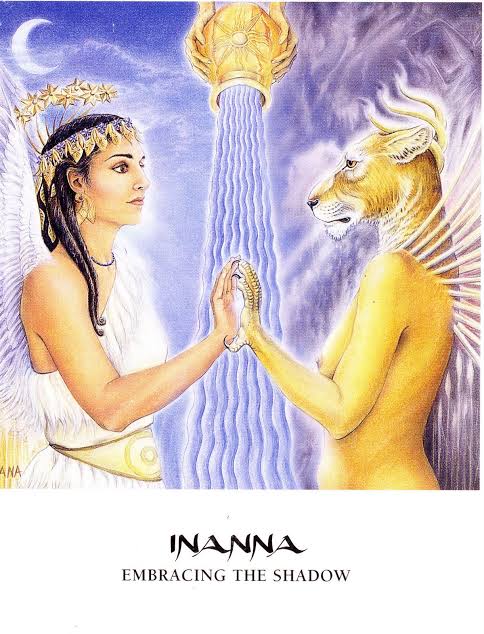
In the birth portal, we can look at the story of Inanna, and the gates she goes through in order to strip down and become whole unto herself. In Pam England’s body of work, Birthing from Within, we pull from Inanna’s lore to understand the process of becoming a mother. Those of us that birthed our child via Cesarean can also relate to this story.
The C-Section that birthed your child into being is no different than the seven gates Inanna had to cross in order to become her full self. Receiving a Cesarean is major abdominal surgery that cuts through seven layers of skin. The initiation our body experiences mirrors the descent into the cave.
The process takes us through a journey that requires a descent through the darkness, and then emerging on the other side of it a mother. I can’t help but notice the similarity to Inanna’s journey through the seven gates of descent as she went to meet her sister in the underworld. She had to sacrifice herself, her body, and die in order to be reborn even stronger. Maybe I’m reaching, but a C-section is a major abdominal surgery that cuts through seven layers of skin.
Maybe I’m reaching but the stages of healing include the states of mourning – denial, anger, bargaining, depression, acceptance; as the body heals in stages, so does this practice of acceptance. It can take time to heal from each stage and level of scarring. Being in relationship with the scar is part of the growth and healing and takes time.
Maybe I’m reaching, but I can’t help but notice that this is a very similar experience to our own rite of passage journey. Not in the surgery itself, but in the reclamation that we too give birth to new life – ourselves and our child – even if we have a C-section. Most importantly, we also need to entrust our care to others as we just had major surgery. We need the support of others to feed and nourish us, tend to our wounds, warm our bodies, and do the work that is needed so that we can rest and heal. The wound that is the site of our child’s birth needs to become a scar that heals, in order for us to become whole.
Becoming a mother is an initiation. Pregnancy is the separation from our old self and so is a threshold. Birth is the transition threshold that offers a portal that we push our baby into the world, and therefore our new identity. Postpartum is the becoming of what has emerged, and so our adjustment time becomes the integration. It is the initiation that comes with the invitation to expand.
Similar to the chrysalis that hosts the goo that becomes a butterfly, we are the vessel of our child’s emergence. It is one thing to emerge, and another thing all together to become. That is a process that takes time. This is why having a ceremony on the other side can be really empowering, like Closing the Bones or a women’s circle.
Marion Woodman shares in her pivotal book The Pregnant Virgin that how you are born predicts your way of making decisions. I was born via c-section and so was my eldest daughter. According to this theory, that means we actively avoid conflict. I had to admit it, but there is some truth to this for me. The original conflict is the push to come into the world. Not that surgically assisted birth is simple, but the coming into the world at that exact moment can be more easeful.
Raising our own children now has a way of playing a game with time. It brings back our own childhood in the present as parts of us become activated. Is my melancholy or loneliness related to my mother? Is our PMS a trait or an example of luteal rage? Am I repeating an inherited intergenerational trauma trait?
I’ve come to believe that we are born at a time when what we have to offer the world is what is needed. Or maybe it’s the healing that my line needed and wasn’t able to do before me. I believe that we are here now for a reason. What I’m learning and unlearning for myself and others is part of the alchemy that needs to happen for change to be manifested. This is especially true for those of us who have children in our lives (in whatever way) because they are the change that we need to keep this momentum going.
“The perinatal portal establishes a spiritual, psychological, and energetic connection from Mom’s present to her implicit, embodied past.” Jessica Tomich Sorci and Rebecca Geshuri, When Good Moms Feel Bad. Our early attachments add to our blueprint and this blueprint maps out the details of our attachment wounds and sense of belong. We know that anything that doesn’t get processed or healed in our childhood can materialize again when our children are the same age we were when we were hurt.
Maybe our children are not our legacy, but our initiation to live more fully and mindfully so that we can step into our purpose. That may be motherhood and it may not. Having discernment is what allows us to trust what is our calling. Otherwise we martyr ourselves and call motherhood our service.
We also now know that egg that formed us was first created in our grandmother’s womb. It might sound witchy, and while it is just that, it is also scientific. Think of your own maternal grandmother. Do you know her story? When was she born, where was she born? It might play a role in your own story as it is all connected.
So it’s not just how we were born and lived our life, but also how our mothers experience it is a model for us. If your mother didn’t know to embrace postpartum (or menopause) or resented it or didn’t understand it, this is something to intentionally unpack and of course correct now in your own timeline.
Take a moment and think back to your own birth. Do you know the story? How did your mother experience it and the early postpartum period?
The care a woman receives in the first 40 days after birth shapes the next 40 years of her and her child’s life. It’s no wonder that there has been a re-awakening towards the care we receive after becoming parents. It is not in fact enough to focus on the newborn’s needs. Newborn parents also need care and support as they too are being born into this new identity.
Birth is the catalyst of transformation. It is not just how we give birth. It is a rebirth of ourselves in this new identity.
All births are a Rite of Passage. We become something new, birthing a new reality into being. How it happens does not matter as much as the fact that it happened. The initiation that is becoming a mother and parent needs the transition stage of birthing a new being into life.
This means we need to be intentional about stepping into being who you have never been before. A mother is becoming something new so we need community, and being seen, as well as resources, rituals and ceremony.
Birthing your baby is the part we focus on, and yet birthing yourself into this new identity of motherhood is an initiation of a lifetime. To be a mother is not just a role but a sacred spiritual transformation and responsibility. To be entrusted with creating new life for this world is no small task and deserves more reverence and respect. The physical, emotional, spiritual and mental healing process that comes after the surgery are a part of our ascent. We need to be held and deserved to be witnessed in this process.
Birth is not just a moment. It’s the ongoing initiation that leads to transformation. Becoming a mother is a sacrifice of who we were and becomes a portal to something new that’s being born, and it not just our child.