This month honours a milestone for me – my partner and i have been together more than not, as we celebrate 25 years together. A quarter of a century. This also comes with other moments to celebrate: My partner and i are officially in mid-life. He turned 50 last year and my own big day is around the corner this year. We see the evidence of mid-life as we have embraced our grey hairs, change in eye sight, my own new friend Perry – perimenopause – as well as the less obvious changes like our soul awakening and the shifts that have happened with our children.
With midlife for parents comes the graduation of no longer being school-age parents. I am now a mother to teenagers. One kid is half-way through high school and has their first summer job, and my youngest is entering her last year of middle school. We are celebrating some magical numbers in my house indeed – 13, sweet 16, and 50!
Our wedding celebration is in mid-July, and in the wise words of Stephen Jenkinson, it offers a punctuation of sorts, a time to pause and reflect on who we are becoming as a couple, as well as honouring who we once were. It is more of a semi-colon rather than a full stop, as life continues to spiral and dance in this meandering way.
Over these last few years, i have been a student of the sacred feminine and well as in soul school. With this comes a lot of confusion. On my part because i never grew up religious or spiritual, and definitely in the eyes of my partner who grew up in a very religious community. As i immersed myself in learning about Mary Magdalene, i was met with curiosity at the best of times, judgement at time, and also just mere fascination at times. With these studies came a learning about the Sacred Union and twin flames concepts. In spiritual terms, a sacred union is when both partners embody both genders energetically.
I’m still digesting what this all means. What my own studies have shown me is the concepts of individuation and differentiation from Carl Jung’s work. It has also offered my partner and i a chance to embody a stage in our adult development that is connected to our deeper sense of self, one that has a (red) thread to our soul.
My partner’s first glances were of concern and confusion with my path but his next steps have helped him find his footing in his own path. Not only do i no longer need his approval, but we know have a felt sense of belonging to ourselves and also belonging together. We fit perfectly together, as the crown of my head rests in the exact spot near his heart and should for me to nestle in.
This is our version of a sacred union. We don’t have to be twin flames of sameness to also mirror each other.
Last year, right after he turned 50, my partner and i started pulling tarot and oracle cards together, as well as did a red thread inspired hand fasting ceremony of sorts under the feet of The Lady of Woodstock. It was our commitment to each other, to stay true to our path and also a way to honour our shared experience.
“To love someone long-term is to attend a thousand funerals of the people they used to be. The people they’re too exhausted to be any longer. The people they don’t recognize inside themselves anymore. The people they grew out of, the people they never ended up growing into. We so badly want the people we love to get their spark back when it burns out; to become speedily found when they are lost. But it is not our job to hold anyone accountable to the people they used to be. It is our job to travel with them between each version and to honor what emerges along the way. Sometimes it will be an even more luminescent flame. Sometimes it will be a flicker that disappears and temporarily floods the room with a perfect and necessary darkness.” Heidi Priebe
We have gone through many seasons as a couple – a long distance honeymoon and early initiation that almost broke us before we truly began, highs like uniting together while living overseas in Kazakhstan (ask me about this life-changing experience if you like), and the ebbs and flow of parenthood. There have been griefs, shared orgasms, and everything in between. And each stage offers a death stage of the one before.
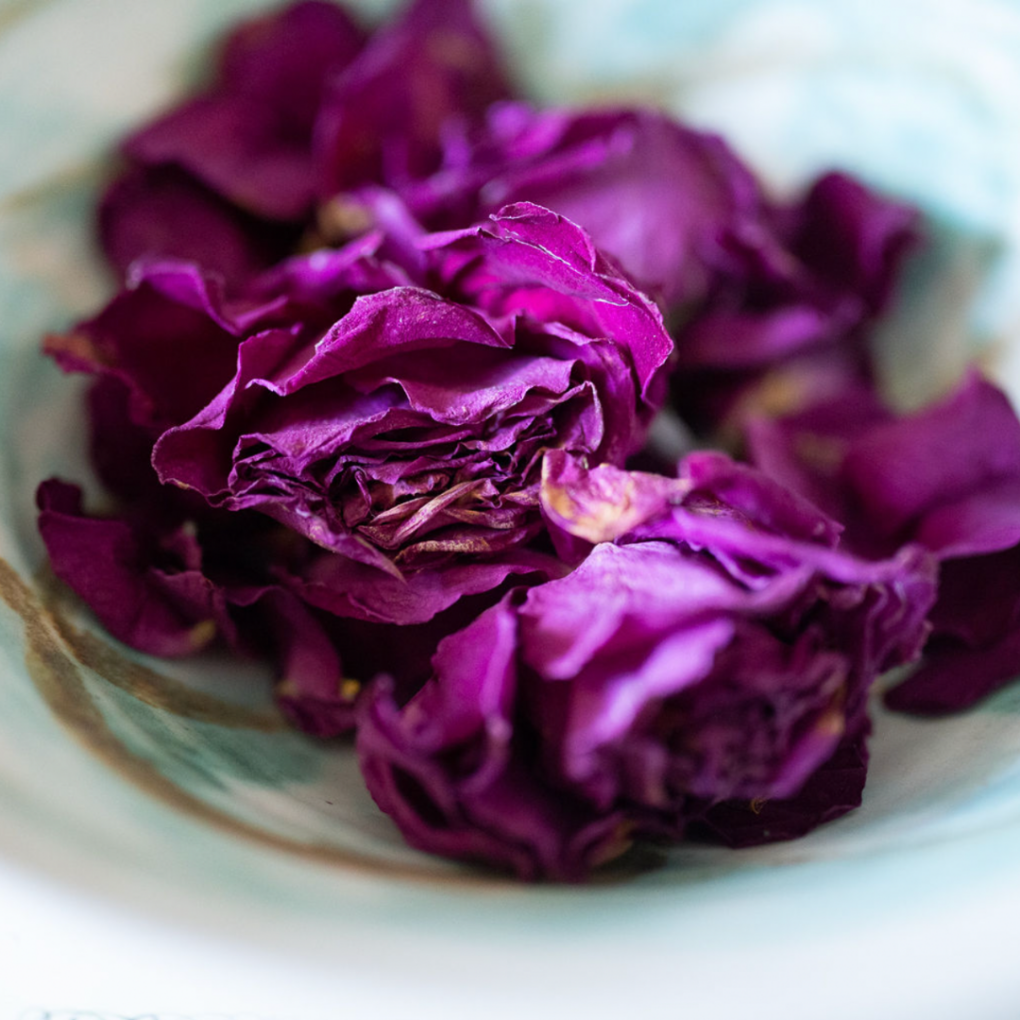 I like to think of my relationship like the growth process of a rose. This perennial flower that grows each year has to go through stages in order to blossom again and again. It needs to be nourished, seen, harvested and pruned regularly. May your relationship have the chance to bloom. It is called a symbol of love for a reason!
Something that can help is the Rose Bud Thorn Seed practice that many of us use as a way to reflect on something, be it at work, for our children or as feedback in a group program. In the context of an intimate relationship, these questions can be used beautifully. I have created some prompts that may help you:
Rose – What is blooming and alive in your relationship right now?
Bud – What is something in your relationship that is newly growing and you are excited about?
Thorn – In what area of your relationship is there something that feels stuck or challenging?
Rosehip – What is something that needs tending to or nurturing in order for your relationship to get
to a new place of growth and bloom? (think of this as a seed that needs to be planted)
Couples go through stages that can last weeks, months or even years. Similar to our inner seasons, a couple’s season can be stuck in a liminal space of no longer honeymoon playfulness and not quite break-up worthy. We are in the in-between, like the goo of a chrysalis. This happens often to partners who are parents together. When we don’t recognize or acknowledge the relationship for having gone through an almost invisible rite of passage, we can experience a lull. Knowing about the stages relationships go through can be very helpful as they offer a map of sorts. We are meant to be becoming new, evolving and maturing. Our becoming is also our undoing.
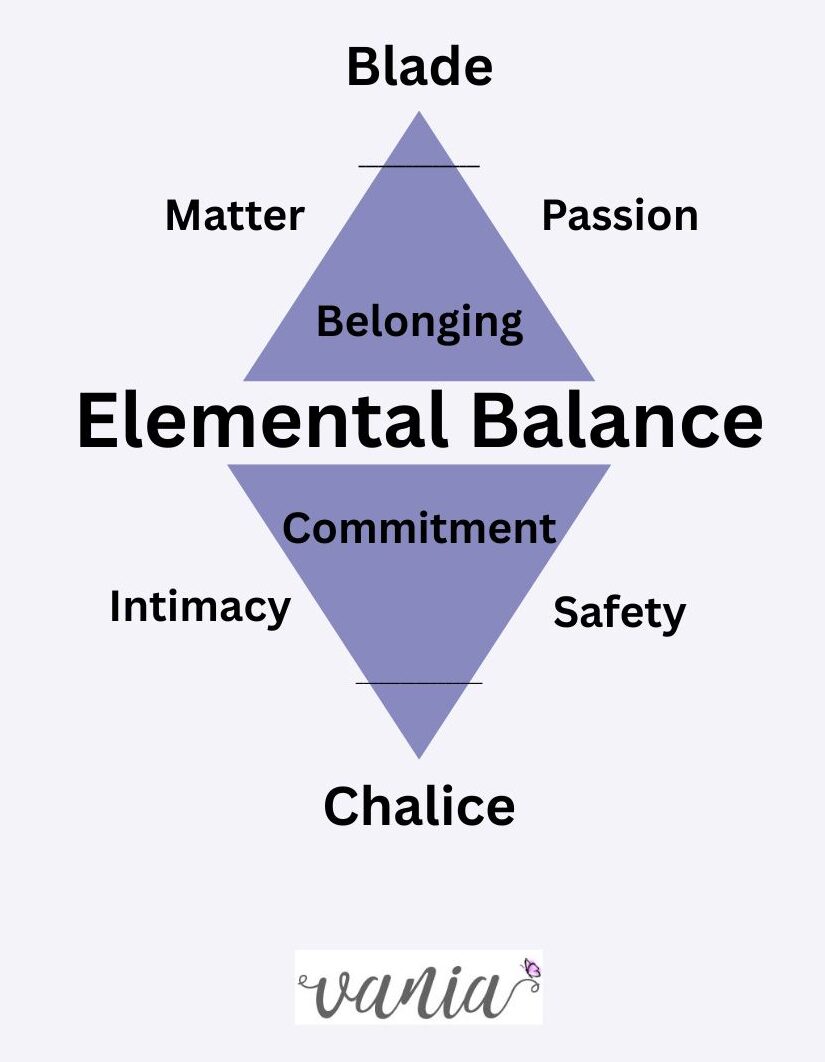
When i get lost on my spiral path, i remember that i have been here before. And wiser folks than me have created maps for us. I am inspired by Carl Jung’s alchemical change with spiritual development and Arnold van Gennep’s Rites of Passage theory.I am also inspired by Jessie Harrold’s take on rites of passage with her Stages of Radical Transformation. She uses the elements very wisely in her book Mothershift, and her example of motherhood breaks down the way the process flows beautifully. I think it can be pivoted well for relationship that moves toward deepening and enrichment. It’s a more elemental and magical way compared to Susan Campbell’s Stages of Relationship Building that i spoke about in a previous journal article.
These stages of transformation offer a perspective on how we can evolve as a couple, so that we may mature and re-align together. For many couples, one party may be evolving at a different rate. That might be in their career, hobbies, or spirituality. This happens often when couples become parents together, and one is experiencing matrescence in a more transformative way. When both parties are dancing at a similar pace and process, it helps them go through a transformation together. They are becoming something new together – The relationship experiences a rite of passage of sorts.
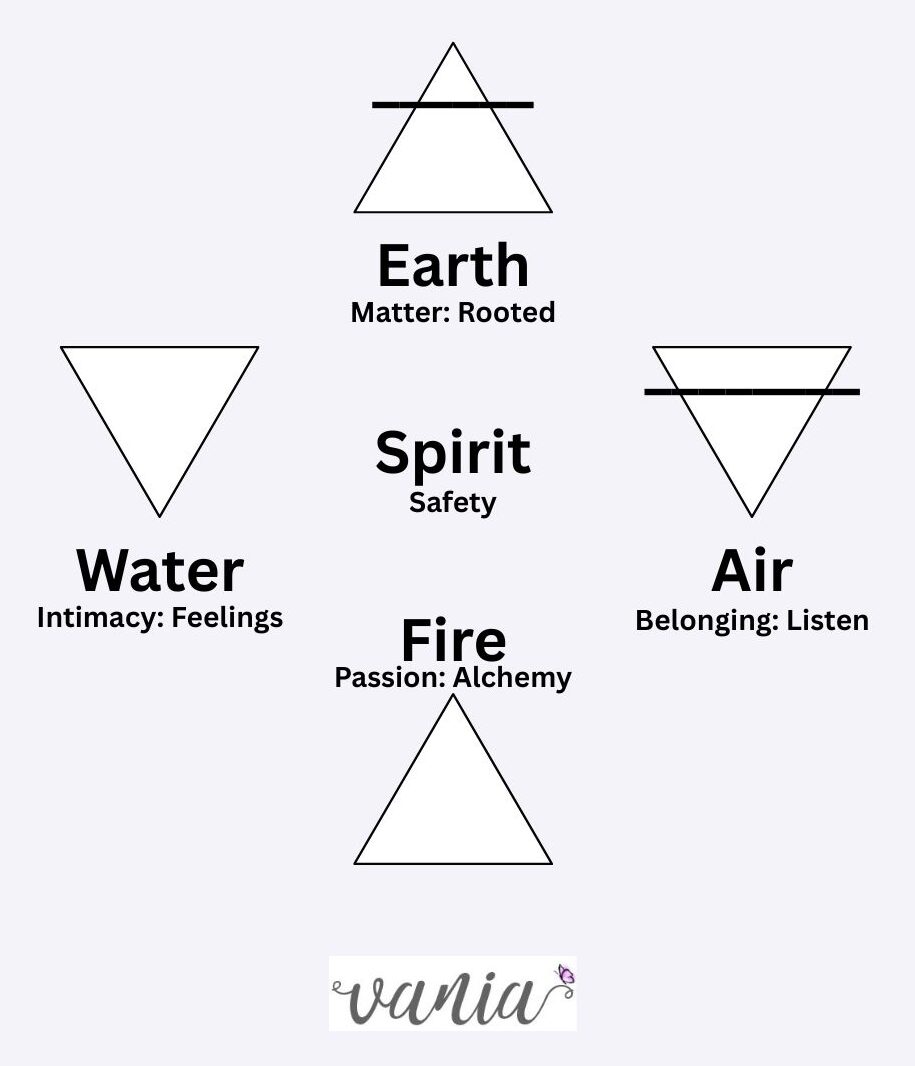
In her theory, we start by landing on Earth. This is where we get our feet grounded in the soil to help us anchor and really get a lay of the land, if you will. What has changed about the landscape of your relationship, what has remained the same? This is a good moment to take stock and do an inventory of sorts. We need to know where we are before we can map where we are going.
Next, we flow to the element of Water, which honours something we know is now ending by sitting with grief. This pause gives us space and intentionality to really see with a ‘grief lens’ what has come to a natural end. It might be well merited or heartbreaking. It still needs to be composted and released to the waters. We flow more fluidity when we are with our loss first. Using the example of having children, it helps to grieve that freedom you may have had as a young couple to go on dates, to stay up late, or to not feel tethered to parenthood.
Now we move towards Air, where the saying could not be more apt: everything truly is up in the air. This is a perfect moment to course correct and also give a change to a new way. We are just moving through the liminal space of that was then, this is now. Air is connected to our thoughts and what is held in our mind. Since change happens through the experience of a catalysing moment, it’s helpful to reflect on what brought your relationship to this point. More specifically, what has gotten in the way and solidified by default? This step cannot be disregarded or bypassed, and it usually is because so many of us are afraid to do the new thing, the third option of taking risk and finding our growth edge. This is what Susan Campbell calls Stabilization, we continue around in a broken loop. Air offers us a chance to come to the surface and not drown in our default.
If we are so lucky to find a life jacket, and come up for air, we get the gift of alchemy. The Fire that reminds us of the passion that brought is into the relationship in the first place. This last stage is dedicated to the element of Fire. This is where we most often skip to or skip altogether. We forget that the excitement of fire needs to be tended to so that the embers don’t fall away to ash.
Here, Jessie offers the practice of Tiny Experiments. These are small and more doable incremental things that you can practice. In the context of a relationship that is evolving, here are some possible tiny experiments:
* Couples Meetings – Call it what you will, a Moon Meeting or Relationship Ritual – but i stand by these meetings that are NOT dates. They offer a chance to do the managerial parts of life without making them the only time to be together. Sit with your calendar and create a shared one, discuss upcoming appointments, plans and tasks. If it sounds like a business meeting, it is – the work of your relationship needs it.
* Mini-Dates – Take turns to create one each week – a song and drink, sitting on the front porch or balcony. These are called mini for a reason, a tiny and doable way to get quality time together. I expand on this below.
* Reach Out when Apart – The Wise elders that are the Gottmans have a term, Connection Bids. I find that so many couples don’t speak the same language, so their requests for connection pass each other like ships in the night. This happens too with words of affection or appreciation. More often than not, what gets articulated are our complaints or criticism, not our admiration or compliments. Send a text throughout the day, or a funny instagram reel. It doesn’t have to be big to let your beloved know you are thinking about them.
It’s important to remember that the stages are not linear per se because they live more in a spiral path, and they unfortunately don’t flow in an organized and even rhythm. Some relationships may live in one elemental stage for years. Maybe one of the elements jumped out at you and resonated with you?
If that is true, don’t worry, there is hope for you yet. This is where relationship therapy, couples counselling, retreats, and so many other resources come in. You don’t have to go to therapy to work in your relationship, but all relationships do require some work – elbow grease and all! If it’s not scary, it’s not intimacy – it requires growth and finding an edge so that you move past comfort zone.
We have to nourish the relationship, tend to this rose garden, and it takes work, just like a garden that needs to be tended to, or our own body that needs nutrients.
As a therapist who works with couples, intimacy, pleasure and healthy relationships, i practice what i preach and live by example. My partner is a non-violent communicator by training and we are both dancing with grief and soul work. So we come by this milestone of 25 years together honestly and humbly. We have learned a few things along the way though, and so i wanted to share some key take-aways from us.
1) Communication is the Key Ingredient
I am pretty sure i have said this before here, and yet it always merits being the first thing i suggest to folks. Learn how to communicate so that you are heard, not just being able to say what is on your mind and in your heart. Communication is more than speaking and it requires active listening on both sides, as well as modelling what we need. It is not just what we say but how we say it, and that doesn’t always mean with our words. Our action and non-verbal cues speak volumes.
2) Make Time for Pleasure and Presence
You may be sharing a life together but maybe it has started to look more like managing a business together rather than an intimate life. When was your last date or shared experience of pleasure? I don’t just mean sexual intimacy but also a shared laugh, cry, mutual delight in a road trip or watermelon? And of course, finding what turns you on sexually can start with the senses that make you feel alive in your everyday.
How do you take time to be present with your beloved? This is a good time to think of these Tiny Experiments i mentioned earlier. How do you microdose pleasure so that you can be more present with your partner?
3) Spend Quality Time Together and Alone
Speaking of spending time together, this is when you pull out your shared calendars and intentionally book time off to be together. You can co-create the date or take turns. What matters is that you take to experience joy, pleasure, and tend to that fire that brought you together in the first place. We need to prioritize shared experiences and appreciate each other’s company. When we forget to do that or take it for granted, the work of relationships forgets the point of it – we are on the same team and we love each other.
We also need to spend time apart as well as together. It is healthy in relationships to have some independent interests and hobbies. This is what Carl Jung calls Differentiation – the ability to stay secure about each other’s interests especially when they are not shared.
4) Notice Which Part of You is in the Driver’s Seat
When we learn what our needs and limits are, it helps to stay in what Internal Family Systems calls ‘Self’ energy. When we can hold this energy, we feel connected, calm, curious, compassionate, and clear about our needs and the moment at hand. So often, our Parts get activated by a conflict or potential one, and it is them that are arguing with other people’s Parts. When we start to be mindful and attuned to our personal Back Story, the Parts don’t take the front seat.
The next time you are in a heated discussion with your partner, as yourself if this feels like the familiar shutdown of your teenage self, or a tantrum of your former childhood. These are Parts that carry burdens, fears and agendas for you know. They can be incorporated into you and have a new role and more appropriate agenda. If you want to learn more about how to get to know your Parts and how they show up in intimate relationships, this book is a fabulous resource.
5) Appreciation
We all have basic needs to matter and be valued. This is hardwired into our body, in our nervous system’s social engagement system. Our basic needs of safety, security and being seen as infants evolves into this more rich need to belong, to truly matter and be celebrated. Similar to missed connection bids, our words of affection or appreciation do not always land as they are meant.. More often than not, what gets articulated are our complaints or criticism, not our admiration or compliments.
We need to be seen, and seen in our goodness. Similar to a deficit in nutrients, we may experience a “nourishment barrier” when the care that is being offered to us isn’t felt in our body, whether it is an insufficient amount or an inadequate offering.
Is it hard to receive love and compliments because you have barriers to being nourished? A trauma imprint gets in the way of nourishment because we continue to scan for safety. It becomes a core wound that imbeds in our body, like a parasite that gets in the way of being nourished by love. This may lead to struggles with low self-worth and feeling like you don’t matter or deserve praise. How do you receive compliments? Does it feel awkward to have attention on you that supports you, validates or recognizes you for your amazing work? Do you turn inward, blush or push away the kind words? This type of barrier can be a way we deny ourselves kindness or appreciation because it makes us feel vulnerable and exposed.
I know that these suggestions are bite-size tastes to what you can do if your relationship is stuck in a rut, or in a long Watery Winter season. I can assure you that when you all agree to the work of tending to your relationship garden, you can grow a beautiful perennial rose garden. And if roses aren’t your jam, wildflowers and a plethora of options are available – just stay away from the foxglove (wink).
Speaking of what may be blooming, i have exciting news! My partner and i have been growing together and i’m so grateful that our gardens co-exist and compost together. We have found an inner rose garden to tend together. Inspired by our 25 years together, we are co-creating a workshop for couples who need a bit more support with their relationship garden. If you live in the Toronto area, stay tuned for some delicious and deep offerings this Fall, where we can help you care for your relationship. We will blend traditional couples counselling with non-violent communication, nervous system support, ritual and a microdose of pleasure and play.