A Mom’s Mental Load: Carrying your own Vasilisa Doll

I just got back from a vacation. My first beach holiday in years. It was to honour my 50th birthday, not as a break from life. Yes, i wanted to slow down and relax, just not to escape my life. Vacations are not meant to to get a break from our everyday life, but to enhance it with a dose of pleasure and adventure. As a global citizen, this is also a privilege to experience other cultures and learn from their wisdom and experiences. The way I do them is to infuse intention, ritual, and soul tending in my time away. If we assume a vacation is going to cure burn-out, we will be grossly disappointed. This is especially true for a week away. If we view a holiday like a personal retreat, that may help. We do also need to integrate the time away into our life. Otherwise, the trip becomes redundant. It becomes a stand-alone event, forgotten quickly.

As a mother, a holiday is especially not a vacation from life. In many ways, it is more work, just different. Mental load, decision fatigue, and overwhelm with less resources play into what gets packed in our suitcase when we travel. Sure, we get a pause from work and that undivided attention to our family gets the front seat. It takes a lot of self-love and will power to also remember we are also on this vacation. Otherwise, we as moms continue to not be seen or heard.
Speaking of which, mental load is not a task itself, but the ongoing running to-do list that never ends. So it’s not so simple just to give part of it to someone else. They also need to start to take on the load that is unseen. We need to move away from the internalized Super Mom part that weaponizes our competence at the same time as challenging our partner’s incompetence. It’s not that they can’t do the work; it’s that it is benefitting them to not have to do it, yet.

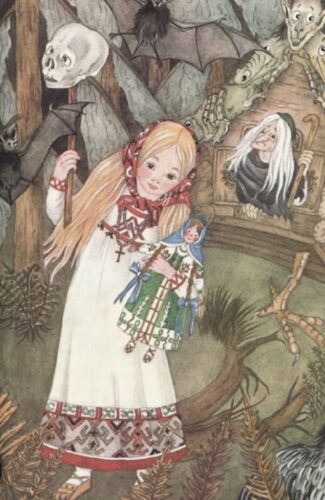
Do you know the story of Vasalisa and her doll? It’s part of the much larger tale of Vasilisa and Baba Yaga. One of the most powerful take-aways for me was that Vasalisa had what she needed all along. If you haven’t read the story yet, you might get some spoilers here so run to get your own copy of Women Who Run with the Wolves and then continue reading.

If you already know of the tale-as-old-as-time story, or don’t have time to read – because truly who does anymore, and that is part of my point with this exact article – continue reading and i’ll play the role of Vasalisa’s doll for you…

Vasilisa was a young girl whose mother died after a long illness. In the final days of her life, she made a small doll that was infused with magical qualities. Mainly they were acts of service that helped Vasalisa during times of struggle and initiation. These acts were what a mother does when her daughter needs support and guidance. It was the doll who helped her separate the poppy seeds from the dirt, who made a delicious stew and meticulously darned clothing, and who cleaned the messy home of Baba Yaga.

Some folks (including me) have interpreted this story as an archetypal mirror to having an Inner Mother or Self-Care Part who can step in when things are hard. The story is about trusting our intuition, our body’s wisdom, and the initiation of becoming an adult, AND ALSO a reminder that we are not meant to do it alone.

So, how does that relate to mom load?

Maybe you also heard Chappell Roan make a bold statement last year in an interview where she talks about her friends who are parents, and referenced them being in hell.

Guess what?

She’s right and what I also think she’s speaking about is that parenting is fucking hard. It’s especially hard these days, in ways that never existed before.

What makes it hard is not that something changed in our children.

It’s that we have lost our way to have a village of support. Who cares for the caregiver?

We get burnt out or overwhelmed and assume the mental load because so many of us want to show up differently (a.k.a. better than we received as children). This can lead to martyrdom. Our to-do list is so long it becomes a badge of honour in our toxic productivity oriented world, and yet it creates havoc on our nervous system. We experience an activated fight response to keep up with all the work, which ultimately impacts our capacity to be present, attuned, and connected to our children.
I’m reading a hot new release called When Good Moms Feel Bad. It is a book that incorporates Internal Family Systems as a reference point for mothers. “The Inner Mother is your capacity for presence, wisdom, and care – qualities that emerge naturally when your parts relax and trust that you can handle what’s in front of you. This is the beautiful paradox of motherhood: in learning to care for someone else’s vulnerability, we develop exactly what we need to be with our own.” Jessica Tomich Sorci and Rebecca Gershan.

Having an Inner Mother is a visual reference of caring for ourselves as we care for others. It is not just practicing self-compassion, but the first preliminary step of tending to our basic human needs. Practising this attunement in our own internal landscape is a way of checking in with our Inner Baby (or child). All those things you’re already doing for your kids? They’re also just what you need. Whatever our children need, so do we. This is where our Mom Parts need to have a dialogue with our Inner Mother – The Parts have competing agendas. “The parts of you who work so hard to make you a good mom are the ones that are the meanest to you. Good Mom parts can tip you out of balance and into burnout.” (When Good Moms Feel Bad) Our Mom Parts want to care for our actual child AND our Inner Mother is the one tending to the child you were once upon a time. This can create an internal conflict when the Parts are polarized.

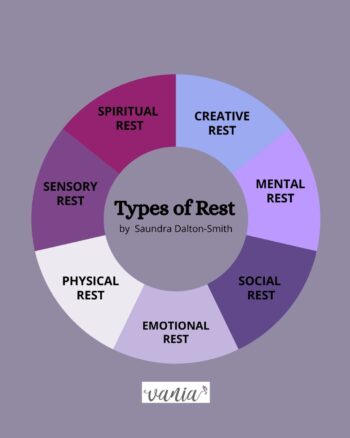
In Internal Family Systems, the model’s aim is to help us access ‘Self’ energy – the most evolved and integrated version of you. And yet, self-care continues to have a bad connotation. Unlike other self words like love, compassion, worth, and esteem, care assumes we are selfish. We are in fact, self-preserving (a hat tip to Audre Lorde). We need to reframe the concept of self-care as the care we give ourselves is aligned with our fullest expression. It needs to reflect who we truly are and not just the parts of us who give ourselves care like a checklist or a to-do list. The rest we give ourselves needs to be rejuvenating and replenishing our energy. It includes pausing by doing nothing AND also creates nourishment in doing so. Otherwise, what we claim to be rest is performative unless it also is nourishing.
The word “self” in this term does not apply alone or only to ourselves. We are not meant to do the work alone. Otherwise, we are left always cleaning up the dominos that fall, being a martyr who people pleases our children, to avoid conflict and also because our own Inner Child is leading the decision. Instead, let us model what asking for our needs look like. We all benefit when we take care of ourselves and it has a ripple effect.

One great way to start to offset the overwhelm and exhaustion is to reclaim micro-moments of rest for yourself. Think of them as “reparenting” opportunities. These are mindful, intentional pauses that help you come back to the present moment. This is especially true when we go on vacation, and is a requirement of everyday life.

This means when we feed our kiddo, are we also checking in to see if we’re hungry? When you’re making your kids a snack, what if you made enough of it so you too could nourish yourself? And, when you ask your kids to come and sit down to eat it, you took your own advice and put your feet up? Or, the next time you wash your kid’s hands after school, take a moment to wash your face and slow down to apply some lotion on your hands and face. Breathe in the delicious smell of this lotion.

So often, women tell me that they make just enough smoothie or kale chips, breakfast or snacks for their kids to eat, but don’t consider their own basic needs. I am not exempt from this – i put out my kids’ vitamins while they eat their breakfast and totally forget my own supplements. They are RIGHT THERE besides my kids’, for goodness sake! Burnout manifests when we set impossible goals AND have internalized the belief that we are meant to tackle the load on our own. Being busy is not the same as being productive. Busy is a reaction to the tasks you have to accomplish whereas productivity is PRO-active and has a larger goal and purpose.

My kids are teens now and travelling with them looks different than it did when the were young. I may not be as touched out as i once was. Mainly because my kids are taller than me now – i have not held their hand in years. I still make sure they are close by when in crowds and ensuring the necessities are packed – like toothpaste, swim goggles, and phone cords. That mental load is a checklist i start writing down weeks before the trip. And while it falls on me now, it is a task i take to heart and is part of my mothering job description. My partner balances it with his own list and load – car rentals, mapping our journey, and learning about the history of the places we go to.

We might be touched out by all the work of motherhood. Maybe the burn-out we are feeling is in fact overwhelm due to our flawed society that still wants us to believe we are naturally meant to be caregivers first and foremost. The mental load we are carrying is not meant to be ours alone to hold. What we call our fault or guilt is our overculture’s false narrative pushing down on us to keep us too tired to make change. To keep us too busy to notice the system is flawed. We are not a failure – the patriarchal, white supremist system is flawed and failing US.

“May this shed a light on the crooked path of motherhood. Momma Zen by Karen Maezen Miller.

One of my favourite podcasts, Moonbeaming, had Amelia Nagoski on it to discuss burn-out from a feminist lens. It was great, and also used a magnifying glass to look at the burnout mothers experience. It’s worth a listen but here is a great quote that really landed for me: “Nothing is going to happen until more help is given.” Here, Amelia is referring to the need to ask for and receive said help, to not continue identifying with the primary lead parent / default parent tension.

We need to remember that postpartum resilience isn’t something that just happens magically in our DNA. We need to build the structures in place so we feel more supported. It’s not just babies that need to be cared for when they become, it’s also new parents.

Rest is whatever refuels us. Taking time to rest is what helps us attune back to ourselves and rebuild our connection to our own Self. When this gets to happen, we can re-orient back to our Inner Mother and the intentions we have as a parent. This is why it helps to carry our own Vasalisa in a pouch wherever we go, as a guide for the initiation that is motherhood. You can think of this as a reparenting reparative experience: We need to do the work to heal. Some things to pack that can help this messy transition into parenthood are:
🌀Having even one or two folks who are further along in their parenting journey as mentors or guides
🌀Reading the plethora of books that exist now more than ever before (but this also adds to mental load)
🌀Getting to visit with the other parts of us that are not connected to our mother role – this includes time to rest, play and be our fullest self when on vacation.
🌀Joining a group and being part of a village of supporting each other and being witnessed in this transition
🌀Ask for help – seriously do it, just call Vasalisa’s name
🌀This “hell” has a name – uninitiated parenthood – so learning about matrescence can lessen this feeling when reclaim it as a sacrifice and rite of passage

The hell is what you make it and it doesn’t have to be this hard.

Asking for help is a key part of meeting our needs as well as modelling that doing so is a sign of strength and part of being a human. We may not get our needs met or the request may not be fulfilled, and yet it’s worth speaking up for ourselves. Why? Well, because a take-away we experience is the truth that we matter enough to ask for help or support even if it can’t be given. This heals the wounded parts of us that remain present in our inner system. They get the gift of an unburdening and evolve into a more helpful agenda. It also helps us not hold resentment towards our own children for the freedom they have that we didn’t receive. We oscillate between anger towards our children and people-pleasing them, as ways to not repeat what was hard for us as children. Neither of these tensions heal our parts. Mainly because they have agendas that are polarized – one is advocating for our own needs alone and the other prioritizes our children because we are afraid they will also feel unloved otherwise.

Remember what i mentioned above, about our “parts?” Our real-life children are not here to heal our unmet needs from our childhood, so cannot heal attachment wounds. It is our responsibility to ensure that the children are taken care of and that’s what we also need to learn how to care for our Self – to soothe her so that we don’t repeat what we inherited.

“A tremendous amount of healing comes from loving ourselves through motherhood, and then witnessing the gift of our healing as it’s shared with our children.” Anne Morrow Lindbergh

And, in case you don’t believe that we model what we need with our children, here’s a funny story that may help. My daughter had a dance recital and when the teacher asked the students what something they need to do this weekend, after the answer is, I’ll take a bath or have a nap my daughter said “ask your parents if they need help.” Not only was I beaming with pride and excited that she knew that and said that answer, I was also proud that my kid was the one that reminded everyone that we all need help, and our kids are members of our home environment. For the record, we are not asking them to take over the adult jobs, but to contribute and to learn how to care for things so that they will know how to do it one day. They also need to know that we are also not superhuman.

Witnessing my daughter say this helps me trust that my kids know me and what I need, at least in theory. So when i heard her say it, i exclaimed with joy “that’s my kid!” She came up to me after and told me how much her friends loved my excitement and called me an icon. That is a win!

So, the next time you travel, feel overwhelmed, and need to rest, make sure you remember to ask Vasilisa for help! You are never alone.
The Paradox of More or Less: It’s Time to Let Hustle Culture Die

Recently, the American Surgeon General shared 2 different research findings that really got my attention. I might be Canadian, but i know our neighbours are not alone in this reality. The most recent one was about parental stress, and last year, research showed that the amount of people experiencing loneliness has reached epidemic proportions.

It’s hard to not notice how both of these very separate results can actually be linked.

I’m going to add a third reality: Internalized toxic productivity that is linked to patriarchy and capitalism. Many women today are their Father’s Daughter, a term coined by Marian Woodman. Not sure what this means? It’s when we internalize the belief that work defines your worth. We internalize the belief also that women are weak, and so we didn’t want to become our mothers. This is the ultimate lie that patriarchy wants us to believe. And guess what? There’s a name for that too: Patriarchy Stress Disorder.

I know i had subconsciously internalized this for years. Throughout my teens and twenties, i moved away from home because i held a belief that staying home meant i would catch the disease of domesticity and become a subservient woman. And then, luckily, in my thirties, i met my shadow and confronted that falsehood.

We need to evolve past the masculine-identified hyper independence of the Artemis archetype to instead embrace the knowing of Aphrodite – our pleasure is our birthright. They may be both maiden goddesses, and yet when we can catch this earlier in life, our spiral path will be greatly altered.

We need to attach our body back to our mind. We are not in fact, walking brains. We are a full human whose soul’s code has already pre-determined our life. Patriarchy and capitalism just wants us to forget this, so that we continue following a groundhog daily grind of life.

We need to trust that we are not a personal development project that always need to be worked on. We don’t need to go on that $2000 retreat to experience an awakening. Coming back to the landscape of our own body and soul’s calling can be the wake-up call. There is nothing to integrate or process.

“Where is your ecological niche? Where is the sore spot in your landscape that needs the shape of your body? The press of your tender foot? Where can you place yourself like an acupuncture needle in the mountain, the clear-cut forest, the web of relations that you, yourself, are woven from? Place me where i can melt into medicine. Place me on the tongue of the women who needs my taste.” Sophie Strand

As Sophie Strand so eloquently puts it, we need to look at our own bodies and reclaim it as a ‘ecodelic.’ It is not about all the supplements to take or the self-care practices to perform. Rather, what about placing your body somewhere on earth, in nature, and be present with your own self. We are our own medicine

We already have what we need.

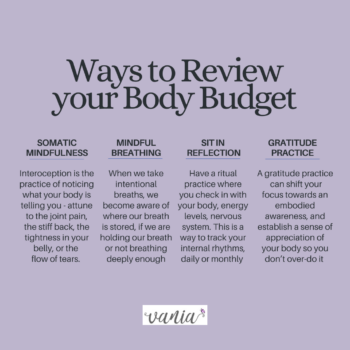
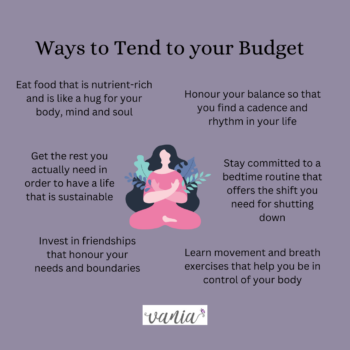
Lisa Feldman Barrett has a great analogy on how to take care of our energy tanks. She uses the concept of listening to our own body’s message (called interoception) to help us attune to our body’s energy level. She calls this practice a Body Budget, a way to put a deposit in my body. This is a great reference to help us listen more actively to what our body is trying to tell us – remember it carries wisdom after all. We have learned to override this knowledge , at the expense (pun unintended) of fitting into capitalist culture.

This is a way to have a mind-body connection to allostasis, and to track our expenses (energy out) with our assets (ways to care for body) so that we have enough in the bank.

I know it’s a bit of a masculine way of tending to our energy levels, this talking like we are money. I see it as reclaiming our abundance, worth, and creating balance. I appreciate that there is a place for healthy masculine energy, and this is where being organized, tracking our energy, and using our cognitive strengths is helpful. Consider how you might put a deposit for your body.

Here are some of my deposits.

1) Take Time Alone
In her soul nourishing book, Gift from the Sea, Anne Morrow Lindburgh shares that “every person, especially every woman, should be alone sometime during the year, some part of each week and each day. How revolutionary this sounds, and how impossible of attainment. To many women such a program seems quite out of reach.”

“Woman need to be alone, to have solitude in order to find again the true essence of themselves.” Here she continues to highlight that the stilling of the SOUL is what matters, not just the activities of the mind or body. It’s not enough to not do things and merely be, what is transformative is the nourishment the soul receives by this stillness.

Lindburgh wrote this book in the 1950s. This truth is no less necessary now.

Another important book that was transformative for me was Rest is Resistence by Tricia Hersey. In it, she encourages us to take time to pause, to dream and rest. This is on its own important. And yet, we underestimate its worth: This time of rest becomes a reset and allows for casting a vision of growth and new dreams, a way to evolve and not remain stuck. Sometimes the boundary we need to set is to say no to more (paid) work that becomes priroitized over the delicious dream seed planted like creative projects that align with your future.

How might you take time for yourself – to dream, to rest, to create, to be?

2) Embody your Experience
We need to recognize those early cues of being tired and fatigue. So many of us override these body messages.

There has been a lot of talk about ’embodiment.’ But what does it really mean? I love how Niva Piran put together these 5 principles, from her own work with body image and eating disorders. If you want to read further about them, here is a great article that unpacks them a bit more.

5 Principles of Experiencing Embodiment:
*Body Subjectivity and Resisting Objectification
*Attuned Self-Care
*Experience and Expression of Desire
*Bodily Agency and Functionality
*Body Comfort and Connection

“What are our bodies are saying about who we are and what we need changes hour to hour, day to day, season to season, life stage to life stage. Self-care is most empowering and effective when it matches our actual needs.” Dr. Hillary McBride

3) Get Lost in a Story
I had a realization recently about why I love reading so much: it is the antidote to my work. As a therapist, I’m also in the origin story or beginning chapters of someone’s life. It’s rare for me to get to the end of their story. It is also such a gift when I do. And, it is ultimately the time in solitude i get – even when escaping into the narrative of the characters or surrounded by people beside me as i read.

When i go on vacation, i read stories with a beginning, middle and end and my friend (who is an editor) shared that she needs quite the opposite – to not read or absorb any narratives. Both of us are practicing self-care, but in our own unique way. That’s why self-care can’t be prescribed. It needs to be embodied and a direct mirror to the need within us.

Books and narratives give me that balance. And that is what self-care and stress management is meant to do – give us balance. Athletes rest their bodies – I get to indulge in a full story, complete with an epilogue!

4) Practice Ritual
Earlier this year, i pulled the Empress card at a Tarot reading. She is the embodiment of rest and self-care. I have also been in communion with the goddess Aphrodite, who symbolizes pleasure and self-love. When i honour rituals that hold these reminders, i remember all over again that we are meant to love ourselves, and to receive care as much as give it to others.

One powerful way to do this is with ritual. Rituals help the soul catch up and integrate through the body the work or info we receive to master our inner knowing, to be closer to divine spirit and full being. It can be as simple as a sacred morning practice, or a ritual bath, or maybe a Sunday afternoon cup of tea and journal session.

Self-care has a role, but is not the answer. The degree it can help you is in the proportion to how much the need is to alleviate the hurt being done. Burnout comes from a push for perfectionism, toxic productivity and poor boundaries. Self-care that is prescriptive doesn’t heal the deeper wounds. This is why ritual is more than just a routine, but rather an attuned and intentional practice that calls for our presence.

We need to listen to the soft cries of our body when it knows we are running on empty.

5) Be in Relationship with Nature
I heard of a concept years ago that has stayed with me since. It goes something like this: Make sure you spend time with nature every day, give or take 20 minutes. When you are stressed or busy, make sure you spend at least an hour outside. I may not have the numbers right, but the point is to ensure you are in relationship with nature EVEN LONGER when life feels full and busy to no end. This is not to add more burden on you (even if it does). Rather, it’s to resource you and help you come back to your body, your breath, and your here and now experience.

We need to choose presence over productivity.

Not only does not help us regulate, by in fact co-regulating with us. It also reminds us that nature is moving forward in a spiral. It is not linear but it is inevitable. Winter still comes and the dark growth in soil happens regardless. Spring flowers still bloom again.

We are nature.

6) Find your Community
Let us embrace the great wisdom of mirror neurons. They show us that we are not only social creatures but also feel inspired and motivated by each other. When we start to practice life in a more sustainable, loving, and kind way, others will also mirror this back.

“The secret to avoiding burnout? Surround yourself with people who aren’t frightened, confused or threatened by your big dreams. Life is too short to talk about the weather, what sport we watched the night before and how work sucks. Have bigger, dreamier more expansive conversations that light you up. That bring out the child-like excitement and curiousity. I honestly think that’s one of the big secrets to avoiding burnout.” Erin Bowe

Let us be in right relationship with others, and embrace the soft strength of connection and attunement. When we add competition to the soup of productivity, it should surprise no one that we end up never satisfied.

7) Let Hustle Culture Die
It’s time to let hustle culture die away as a forgotten misstep. As we enter the dark months of this year, let us remember that this is the year of Soft Strength. As we start to turn towards the next year, what do you want to let die? What internlized hustle or work ethic has run its course?

If you need any more inspiration, let me be the first to tell you that next year is held by The Hermit in Tarot – the 9th card in the major arcana story urges us to become hermits, to turn inward and rest, to find our inner caves and just let the work fall away.

“But this hustle culture mindset fosters unhealthy perfectionism, overcommitting, insecurity, self-neglect, and isolation. Even our proudest achievements cease to have any meaning for us; they’re simply a row of checkmarks on a never-ending list, a line of stepping stones toward a destination we will never reach.” These reflections come from Israa Nasir, who wrote a new book called Toxic Productivity. She goes on to share that the antidote is not to be unproductive at all. Rather, it’s about ensuring that our goals are balanced and includes our personal growth instead of competing with others. The work becomes sustainable and has scaffolding that ensures we don’t forget our own values nor burn out.

8) Be Aligned with your Values
It’s time to reframe away from the story that our value is connected to production and more more more. We don’t in fact have to see more clients to be good at what we do. We don’t have to volunteer in any place, let alone 3 different charities that don’t appreciate our free labour. We don’t have to read all the books and work on social media (again for free) just to have a big following.

Our personal value has become measured not by what we’ve produced already, but by how today’s production can help us produce tomorrow. That keeps us doing doing doing, at our own expense (there’s that word sneaking in again). We are also judging our success by how tired we are – the more exhausted has become the goal.

Come back to what you value. What is it that lights your inner spark. It’s absolutely good to want to volunteer and be an active member of your community. What is also important is that you are not running yourself on empty to do so. What is your soul’s code and service to the world is important, and so is how you live your life. Does it include pleasure and rest, time for yourself and your loved ones?

9) Reframe How you Talk to Yourself
A pesky inner voice (my Bank Manager Part) urges me to hustle. “But as some of us reach adulthood, these lofty goals tend to boil down to a single, urgent imperative: in order to have value, we have to produce more value. Israa Nasir

When i take time to notice that is not only NOT my voice, it is a voice that forgets that my worth is inherent because i exist and rest is not just resistance but also a paramount need.

I already knew i was in mid-life, and now i know that i’m even closer to a more formal marker of it. I’ve reached my Fuck It Era – and it’s quite close friends with The Hermit.

“When a woman stops doing, she must learn how to simply be. Being is not a luxury; it is a discipline. The heroine must listen carefully to her true inner voice that means silencing other voices.” Maureen Murdock

An Eternal Flame – How to Say Hello to Mom Burn-Out

I’m a mom. I’m a feminist. I’m a therapist for women. I am a feminist mom wholeheartedly. And yet i am faced with that beautiful vulnerability of being flawed like anyone else: I am burning out.
My little flame is wavering a bit.

It is not lost on me that i am a therapist who supports new parents, especially mothers, with the transition into parenthood. And i can’t help but feel the grasp of imposter syndrome that I too am immersed in the impact of Impossible Parenting. I do all the things i suggest to others. That’s not the point – in fact, it’s much bigger than me and what i can do for myself. As i grapple with parenting my children in real life, and in public, i feel a self-imposed burn of pressure to be Mary Poppins perfect – what kind of model am i to others if i too am struggling to keep my kids’ (and my) shit together at the Grocery store? Ugh – the pressure can be too much, and then i seek out my self-compassionate voice and breathe a bit better. I love the lists of ways to heal from mom burn-out, but those are band-aid solutions and not touching on the root of the problem.

I chose to be a parent, i wanted kids and i love the idea of the matrescence rite of passage. And yet, part of me wonders if this is all it is?

I love my life. I really do. This isn’t a passive aggressive way to try to get a message to my partner. (though this open letter to dads is great!). I also recognize my vast privilege as a white cis gendered woman who is able-bodied and partnered to a cis man who i love and have a healthy relationship with, where both of us have permanent work.

And yet…

I’m so tired. And irritable. And cranky. For a while, I thought it was work overload then I wondering if I’m not practicing what i preach with work/life balance. So i read some books, slowed down some evenings, met up with friends here and there, did less work after-work hours. And still…i was crabby.

I love the work of Esther Perel that reminds us how we put on our good work pants for work, only to take them off when we get home. Then proceed to show our own family our more authentic and messy side. Like I should still be wearing my nice pants all day, or at least notice how i present my good side only at work.

At first, i thought ‘oh oh’ I’m not being so kind to my family and felt self-critical of my own internalized want to have it all at the same time. I was sad with myself for putting work first, and being tired by the end of the day, when my kids needed me. And then i realized, “huh, what is playing a role in me feeling this way.’ Surely it’s not just my own doing.

I think I’m more right about that side of the coin.

A few weeks ago, i had to point out to my beloved dependents that people come to see me on purpose to help them when they are sad or stuck with a hard feeling and decision. And yet, my kids will yell over me to keep arguing with each other. For a while, i would be ashamed that I could not be able to help them de-escalate or regulate their feelings – that’s what i do ALL DAY long at work after all. I realized then and there that maybe i am better at helping others who want to be supported, and that my kids need me in a different way.

Sure, i know they need me to model self-soothing behaviour and emotion regulation. Sure I have the tools – i even make a real toolbox for them.

I’ve begun to resent weekends. Sure, i practice what i preach – i take time for myself in the evening and don’t always do the dishes, unpack lunch bags, put stuff away. Sometimes i watch a show by myself or write articles like this one… And feel guilty about it. The idea of a mini mom vacation sounds decadent and yet i know it’s just a band-aid solution.

I do live from a family-centred place and attachment theory is my jam. I get hugs and love from my family, even a thank-you and I’m sorry sometimes. I don’t want to be worshipped per say, but to be more appreciated and noticed would be great. What i need is less work and chores and tasks and requests and and and..

I love all the articles on social media that remind us of the mental load of mother’s work (and yes it’s quite gendered still, and also still seen under the umbrella of women’s work). I’m glad we are acknowledging this burden and current iteration of sexist division of labour. Motherhood is still tasked by the same glass ceiling that we feminists fought for some many years ago. I wish i could turn off the brain thinking part of the mental load of mothering. Yes, it’s a verb now too.

For instance, here’s a run-down of some things that i carry in a given week:

* I once woke up in middle of night to pack a swimsuit for my kid’s class – i went to bed knowing i forgot something!
* I keep the health cards even though I now hate the sight of blood (and I learned that after my son fell off a tree into a river on a vacation and needed stitches – that i wanted to get him but my partner’s didn’t think were necessary)
* On that note, i wake up through the night whenever my kids move, or cough, or cry out
* i am a sous-chef that knows my son only likes raw veggies and tomato soup and my daughter hates the idea of sandwiches
* I have to get the rascals out of bed while he makes lunches – yes I’m grateful he makes lunches because it’s a yucky job, but what’s easier?
* I know exactly how to pour their juice in the morning so that one is not jealous that the other got more to juice (not to drink it mind you, but you know “fairness”)
* I coordinate playdates for the weekends that I work or it’s not my turn to take a day off for a PA Day
* I know what their favourite socks are and where to find them
* I know when they have homework, or class trips, or birthday parties and send in the forms and RSVPs
* I book childcare for the 4-times-a-year date nights
* I know when the birthdays are of their friends!
* I feel guilty when i am at work on a Saturday or can’t make it to them if the school calls mid-day
* I know when the tooth fairy is going to visit and save the coin for that night
* I have forgotten twice and felt so shitty

There is no such thing about a maternal instinct. You read that right – there is NOT one but rather we are taught and learn how to be moms. Who reading this has babysat at a young age, or was taught how to mend socks and buttons, or what is best for a sore tummy since you were a child yourself? Yes i do know that men of my generation may have learned this too, but are they doing all the other things too? Do they stay up thinking about all this too? When we list what we do and thing about, especially during that 3rd shift of labour in a day, do our partners say “i took out the trash, or changed the litter box.” Yes thank you sweet lover, but do you also wake up worrying about your kid’s strained friendships or start planning their birthday party 2 months ahead of time?

Just look at all the books dedicated to this – they all are geared to mommy blog readers, or mommy mojo sex fullfillment, or mama rage. And guess who reads these books and articles? Yup, moms and women. So, while I’m a glass half-full gal at the best of times, I’m not so sure this will change.

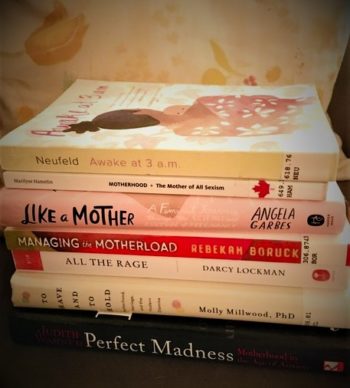
Don’t get me wrong, i read all those books and enjoy most of them. This photo is just some of the books i am reading right now, in fact. My partner has yet to finish one parenting book – but he chose a good one so I’m glad he has that under his belt. And i do love my self-identified label of mom. I even loved it was the first word of both my babies. And yes, i identify as a mother, not a parent. Go figure. I even loved it was the first word of both my babies.

And again, i will remind you that i love my partner dearly, our relationship is absolutely solid, and he is a very hands-on, active, and available dad to my our children. This is about him nor needing to change our roles, gendered or not. It is bigger than just us. I am so grateful for all my partner does. The homemade bookcases and winter tires and …

And yet…

(( written by a tired and grumpy Middle Aged perimenopausal woman ))