Raising Teens: Becoming the Lighthouse

I am just back from a vacation of a lifetime with my youngest. It was our first ‘just the two of us’ trip. It was to honour her passage into high school, and so l gave her a girls’ weekend at a favourite city with all the perks of a city that never sleeps – shopping, good food, and lots of selfies.

This summer has been all about marking this developmental transition of adolescence. My big kid was home alone overnight for the first time, we had our first parents-only camping trip, and both kids got a big trip with just one parent. This is us honouring what is ending and also becoming. And, i don’t mean what is happening for our kids. We too as parents are in a transition season: The end of school-age parenthood needs to be honoured in ceremony. It may not be a major life transition but it is still a rite of passage.
I’m glad i’m not alone in wanting to honour these initiations with some type of pomp and circumstance. I’ve been watching the show Sterling Point with my youngest. It has been such a good bonding opportunity as we watch certain episodes, stories, and themes. We have a cottage near the location so it’s an added bonus to watch the show from this vantage point. One storyline that i loved was how the group celebrated Maple starting her menstrual cycle. They made her a flower crown, howled like wolves, and shared advice. I had a ceremony for my daughter when she started her menarche. At the time, she was not as into it as i am, so seeing this portrayed in the show was really exciting for me. It normalized ceremony as an important part of growing up. If you want to see my hot take on the show as a therapist and mom to teens, take a look at my recent instagram post.

In the coming weeks, both my kids will be in high school. This is a pivotal rite of passage for me as well as my youngest kiddo. It dawned on me only a few weeks after school ended that I need to honour the rite of passage for myself. It was our last year at the same tiny alternative school both my kids started at when they were a mere four years old. She celebrated the end of an era for herself. She had a party after-party, and got all dolled up. As much as we honour commencement and ceremonies for our kids when they’re moving through different pivotal stages of school, we also need to have a way to mark this for ourselves. And so this is something I’m noticing I need to do as my youngest starts high school.

And so, I am working on crafting a ceremony for myself to honour the arrival of high school. I need to mark this transition for myself, and i suspect other mothers will gladly participate to honour this threshold for themselves too. Plus, i am always looking for a good reason to host a ceremony.

It is time we brought back more ceremony into our lives, and less superficial celebration.

A rite of passage is not just celebrating the transition. It is needs to include some work and letting go. It needs to honour what is ending and also offer a bit of elbow grease. Marking it in this way offers the somatic experience of The Return, the coming back but anew felt sense. In Arnold van Gennep’s Book, Rites of Passage, he shared that this step is key and often overlooked. Having time to to integrate an experience is as important as embarking on it. We may not go on pilgrimages as a society anymore (though i definitely advocate for one) but we can practice a modernized version of a quest. It might look like a camping week, a portaging adventure, a summer work experience, or a trip.

Maybe not the most fancy of activities, but one thing we did was request some household projects to be done by our kids. As part of my teenagers experience for the summer, we had them do a few tasks and chores around the house. Some of things that they’ve never done before. And so when my eldest was sanding down the deck, I noticed they were sitting on our rickety outdoor dinner table. I asked them to not sit on it because it was precarious. They grunted and complained and rolled their eyes at me, but stood up. An hour later, they came up to me with the invisible tail between their legs and admitted that they sat on the table again and it cracked.

The moral of the story isn’t that they did the thing I told her not to. It’s that they felt safe to come and tell me they did the thing and knew I’d be upset and possibly even say I told you so and they still came to me because they couldn’t fix it alone. They trusted that even if I was angry at them that the love was always going to remain.
This is what I want to happen if they were ever to do anything out in the world that made them feel scared or in danger: To call me no matter what.

As the saying goes: Small kids, small problems; Big kids, bigger problems.

Raising a teenage daughter today is a modern-day version of the myth of Demeter and Persephone, but the lure is social media and not Hades. Or maybe social media is the new Hades, in a more modern trickster suit. I’m fighting to keep my daughter close but I am competing with a greater force and that is her phone. I’m not fighting my kid about her phone, I’m fighting the attention the phone takes from me. Our smartphones were supposed to be a place we sometimes visit, not a place that we live in all the time. This is my work-in-progress project. As my teen enters the high school jungle, i know that i need to hold onto her a bit more. My grip may not be as tight but it needs to remain nonetheless.

I’m needing to do that consciously and not reactively, so that I don’t fall into anxiety and instead have a clear path that helps me stay clear and secure. I need to also do this in a way that doesn’t lose myself in motherhood as I enter my new Virgin territory.

Many of us are raising children and being parents as an over-correction because we were raised by parents that were emotionally immature or unavailable and so we want to be the most present, attuned, available, and understanding parents to our own children now.

I remember having fights with my own mom about my friends, how long i was on the phone at night, and our competing needs. Now i see it as normal teenage woes. Back then, I grew up being told by my mom “wait until you have a teenage daughter. That will be your karma.”

Maybe it’s not revenge that my kid is giving me a hard time. Rather it’s destiny as a developmental stage. Teens are meant to protest as a way to build individuation. I know this now. I also now see that my mom may have been going through perimenopause at the time i was a teen, and i really wish this was spoken about then. I get back to this point soon.

A part of healing these parts was to first unlearn that anger is scary or destabilizing so that my children can embody it more fully.

I have internalized a wound of unprocessed anger due to ongoing unmet needs, and it is what is fighting with my child at this developmental stage. What i couldn’t say to my mom back then is hard to hear my kid say to me. It’s not karma that i have a sassy kid. It’s a pattern that has taken generations to get to me, and i can now heal what wasn’t repaired. My own Inner Sassy Teen Part is very headset on being able to say what she needed back then. My Mother Parts need her to remember that my kid has her own needs now.

Our teens also lose the mother that they had as a younger child themselves. Gone are the play-based days, the years of wonderment and mini-me dress up. We must grieve the end of that chapter, so we can accept and birth this new one that evolved from it, and also offers more depth and closeness in the present.

‘Becoming a mother leaves no woman as it found her. It unravels and rebuilds her. It cracks her open, takes her to her edges. It’s both beautiful and brutal, often at the same time’. ~ Nikki McCahon

Matrescence is the adjustment period to motherhood, and I think this initiation of becoming a mother to teens needs its own great passage or marker so that we don’t step into it unconsciously or uninitiated, but rather with our eyes wide open. I thought i was moving out of the stage of motherhood, only to realize that it is more that i was moving into a new stage OF motherhood. I was getting excited to claim the identity of Mage/Queen/Virgin, but i am not there yet: I may be perimenopausal and i am still mothering. I’m a baby mage, eager for this new stage of life but it is not yet where i stand.

I’m still crawling.

I am one of the mothers now who are in perimenopause while my children are in puberty. We are not supposed to be at these intersecting stages. In a recent issue of Hot Flash Mag, Jessie Harrold says it so well: “Here we are losing that biological wiring to nurture, and our kids actually need more from us than they probably would have for our foremothers. So there’s this real tension and conflict. The mothering I thought I was going to be doing at this age is very different from the mothering I am doing, which is far more intensive.”

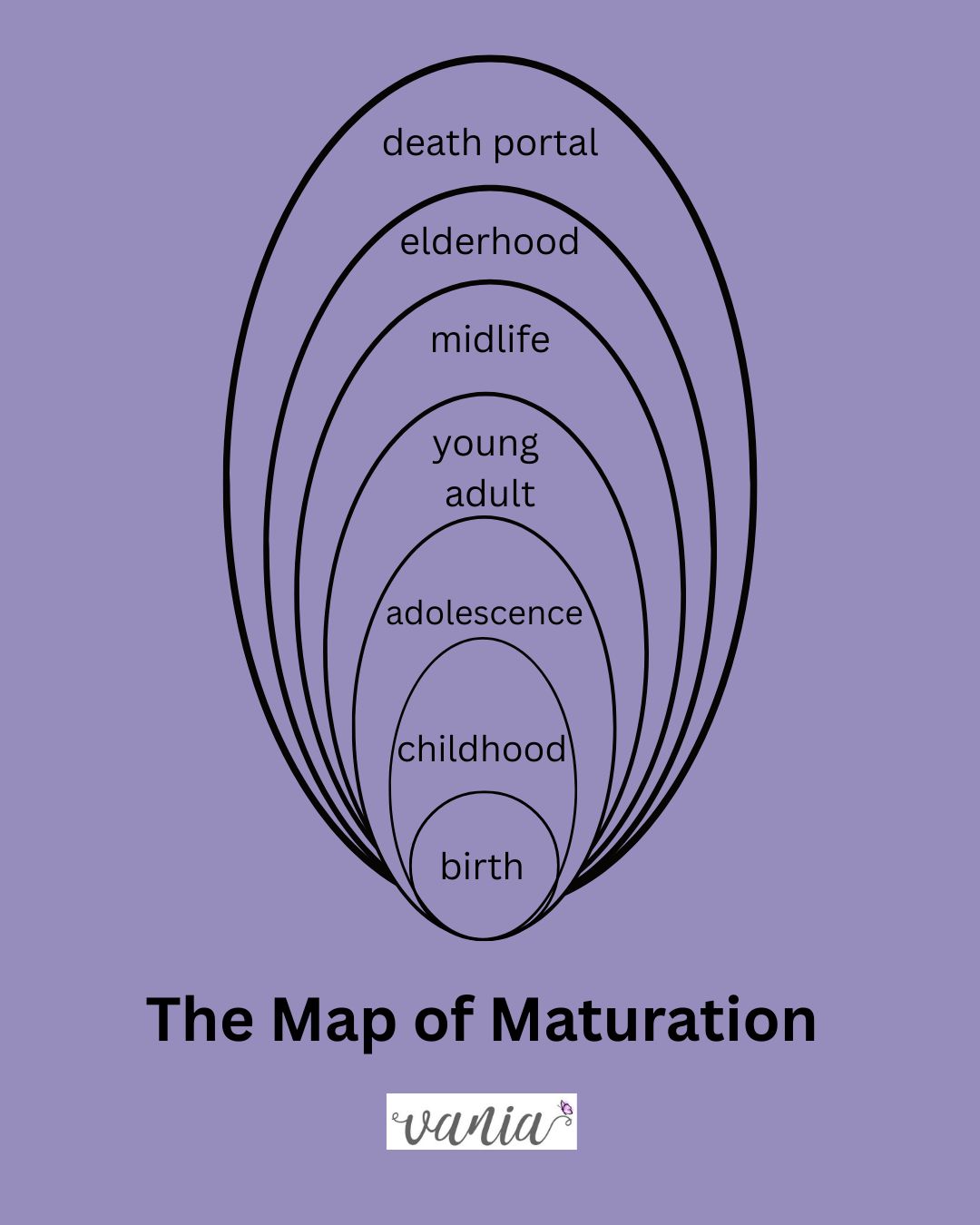
A part of the becoming that happens is that we put on a new suit as advocates and mama bears for our children. No one‘s going to have our kids back like we do; even when we say no to our kid it’s because we have the best interest for them in mind. The tension is that our kiddo may not see it that way, and we need to stand our ground. This is where the messy hormonal conflict can pay a role, and be a toll on our connection. I need to remember my role as a parent is to guide my children to their fullest potential, to grow and evolve, to reach maturation. For this wisdom, i thank Gordon Neufeld.

Parenting teens is learning to embrace your new role as the lighthouse keeper. You are now watching from the beach. You are close enough to touch them, to see and hear them and just enough distance for them to find their own way. In Kim Jon Payne’s book, The Art of Discipline, he offers another theory – the 3 stages of Parenthood – the Governess, Gardener, and Guardian. I am embracing the newly minted Guardian role. It is a time of becoming the guide for my children, not activity playing or weeding like i have been.
Whenever i get a bit lost in the waters of motherhood in modern-times, i come back to my anchor, that is remembering my role as a mother. In their book, Sil Reynolds (now Read) and her daughter Eliza, Mothering and Daughtering, offer us some insight and guidance on how to move through this messy stage. To start, Sil shares that “Mothering” can be seen as a verb, the action of helping our children become the adults they are meant to be. She also offers that we need to incorporate intentional quality time together – like my big trip with my kid and watching teen dramas together. It also serves us to understand counterwill and learn to read our child’s cues. This has been such a life saver of mine over these last few months. And it’s still a work-in-progress.

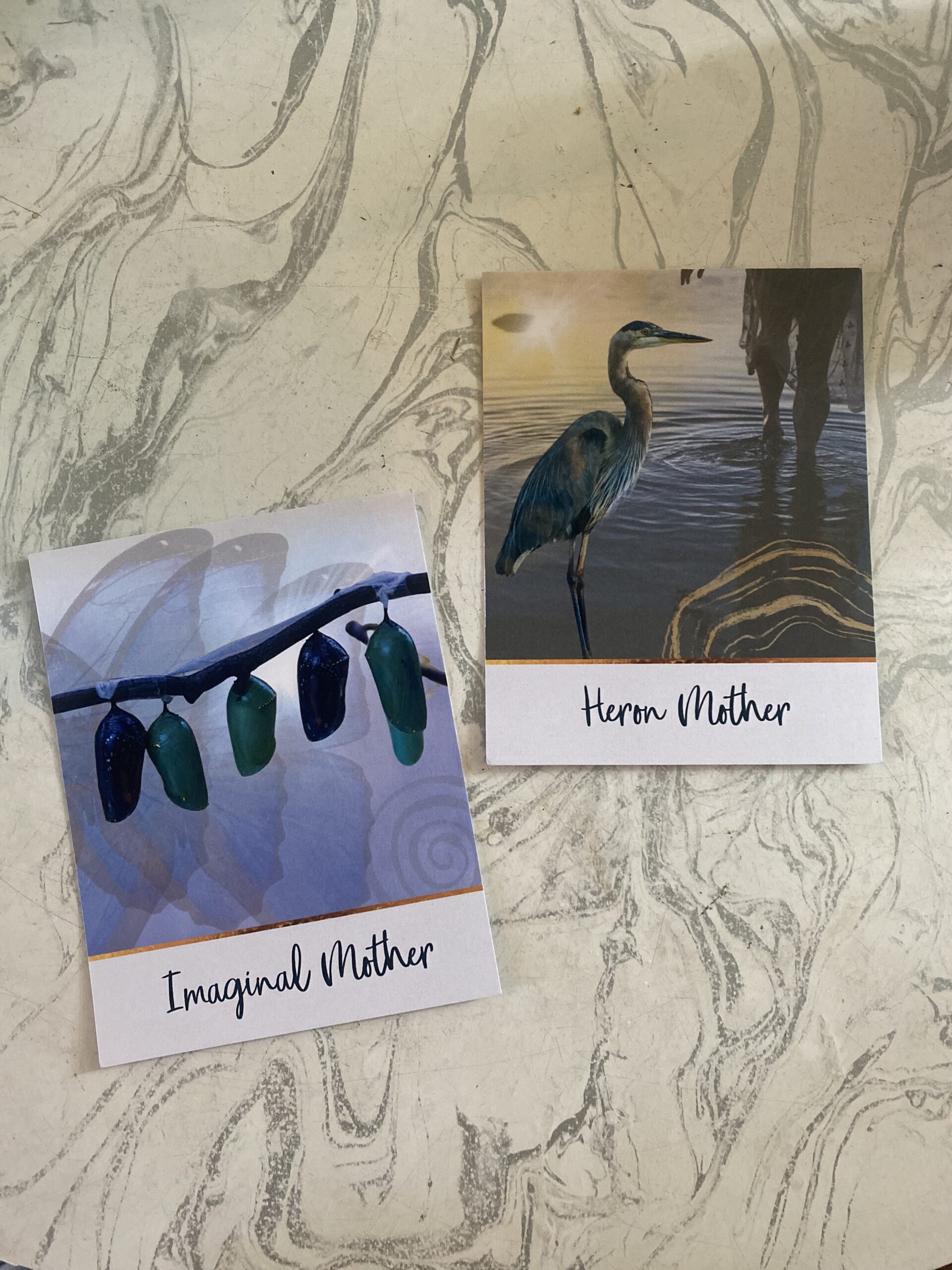
I was recently gifted a beautiful deck of cards by my friend Jessie Harrold. She wrote the wonderful book Mothershift, which is a guide through matrescence and finding our north star as parents. This deck is a visual reference that helps us see what kind of mother we are at a specific moment in time. I am no longer the Crafty Mom or archetype. According to Jessie, I am the Heron Mom: I am walking the threshold between who i was a mom and who i becoming. That means i need to trust the magic and also grieve what is no longer true. I can feel the pull of the Imaginal Mother who is becoming who i truly am, but it will take time to mothermorphize (a word Jessie and i made up) as my kiddo has to adjust to being in high school herself, first.

Speaking of getting lost in the waters, one thing i do when i feel like i’m drowning in unfamiliar waters is to seek out who has been here before. This new terrain of mothering teenagers may be new to me, but i am not the first parent to do so. This is not uncharted territory. Ideally, this is where mothering mentors come in. I have found some older mothers in my life that i can turn to at times, but not consistently or for the actually themes i need support in. Since we live in a society that is void of true mentorship, i have to turn to some other guides. Folk tales, myths and the timeless stories of our ancient ones and ancestors.

And, for me that includes looking at mythopoetic stories that depict motherhood in universal time and space. It’s a good thing that there are many examples. One of my favourites is the story of the Greek goddess of Harvest, Demeter, and her daughter Persephone. It is Persephone (or Kore’s) journey to the underworld and her mother’s grief of losing her daughter that we can thank for our seasons.

What i have also found is that the story of Persephone as many variations. For instance, Carolyn Elliot shares in her powerful book, Existential Kink, that maybe Persephone’s journey was in fact subconsciously manifested by herself as a way to integrate her shadow parts and becoming whole. We need both our conscious and unconscious parts to complete us after all. And maybe, Persephone’s flight to the underworld was her way to get space from her over-bearing mother. Maybe she needed this time to find out who she was. So she rebelled and flew the coop (like i did at 16, incidentally). This allowed her to find herself and integrate the tension of opposition and reliance, struggle and ease, independence and connection. And Demeter herself had to reckon with the truth that her daughter needed to find herself separate from her role as a daughter. I like to think that Demeter had to grieve losing her daughter as a maiden in order for her to find herself in mid-life as a woman herself, and not just her leading identity as a mother. In her acceptance and surrender of Persephone’s individuation, Demeter was initiated into Virgin Mother territory – a woman who belongs to herself first, who is whole unto herself and who has the qualities and strengths of a Mother. She no longer puts her needs last, she models that having needs is not only okay but a part of being human. In fact, it is through her practice of caring for herself that she is paving the path for her child to reach individuation and maturation herself.

So maybe the story of these two goddesses set the stage for us all along. Maybe they carved a path for us to follow but we forgot that Persephone needs to find herself on her own, and we are meant to grieve what is ending – not the relationship but itself but the duties that came with it change over time. Grief means needing to say goodbye to what was in order to become anew and also find our new meaning. Maybe our modern-day experience raising daughters is not that different than Demeter and Persephone’s. What offers me solace is that it is just a stage and Persephone comes back. When we trust this, it makes the grief in Winter tolerable.
A Mom’s Mental Load: Carrying your own Vasilisa Doll

I just got back from a vacation. My first beach holiday in years. It was to honour my 50th birthday, not as a break from life. Yes, i wanted to slow down and relax, just not to escape my life. Vacations are not meant to to get a break from our everyday life, but to enhance it with a dose of pleasure and adventure. As a global citizen, this is also a privilege to experience other cultures and learn from their wisdom and experiences. The way I do them is to infuse intention, ritual, and soul tending in my time away. If we assume a vacation is going to cure burn-out, we will be grossly disappointed. This is especially true for a week away. If we view a holiday like a personal retreat, that may help. We do also need to integrate the time away into our life. Otherwise, the trip becomes redundant. It becomes a stand-alone event, forgotten quickly.

As a mother, a holiday is especially not a vacation from life. In many ways, it is more work, just different. Mental load, decision fatigue, and overwhelm with less resources play into what gets packed in our suitcase when we travel. Sure, we get a pause from work and that undivided attention to our family gets the front seat. It takes a lot of self-love and will power to also remember we are also on this vacation. Otherwise, we as moms continue to not be seen or heard.
Speaking of which, mental load is not a task itself, but the ongoing running to-do list that never ends. So it’s not so simple just to give part of it to someone else. They also need to start to take on the load that is unseen. We need to move away from the internalized Super Mom part that weaponizes our competence at the same time as challenging our partner’s incompetence. It’s not that they can’t do the work; it’s that it is benefitting them to not have to do it, yet.
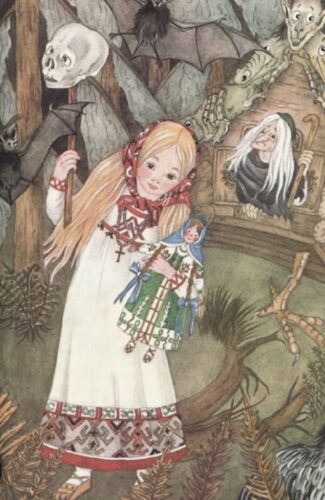
Do you know the story of Vasalisa and her doll? It’s part of the much larger tale of Vasilisa and Baba Yaga. One of the most powerful take-aways for me was that Vasalisa had what she needed all along. If you haven’t read the story yet, you might get some spoilers here so run to get your own copy of Women Who Run with the Wolves and then continue reading.

If you already know of the tale-as-old-as-time story, or don’t have time to read – because truly who does anymore, and that is part of my point with this exact article – continue reading and i’ll play the role of Vasalisa’s doll for you…

Vasilisa was a young girl whose mother died after a long illness. In the final days of her life, she made a small doll that was infused with magical qualities. Mainly they were acts of service that helped Vasalisa during times of struggle and initiation. These acts were what a mother does when her daughter needs support and guidance. It was the doll who helped her separate the poppy seeds from the dirt, who made a delicious stew and meticulously darned clothing, and who cleaned the messy home of Baba Yaga.

Some folks (including me) have interpreted this story as an archetypal mirror to having an Inner Mother or Self-Care Part who can step in when things are hard. The story is about trusting our intuition, our body’s wisdom, and the initiation of becoming an adult, AND ALSO a reminder that we are not meant to do it alone.

So, how does that relate to mom load?

Maybe you also heard Chappell Roan make a bold statement last year in an interview where she talks about her friends who are parents, and referenced them being in hell.

Guess what?

She’s right and what I also think she’s speaking about is that parenting is fucking hard. It’s especially hard these days, in ways that never existed before.

What makes it hard is not that something changed in our children.

It’s that we have lost our way to have a village of support. Who cares for the caregiver?

We get burnt out or overwhelmed and assume the mental load because so many of us want to show up differently (a.k.a. better than we received as children). This can lead to martyrdom. Our to-do list is so long it becomes a badge of honour in our toxic productivity oriented world, and yet it creates havoc on our nervous system. We experience an activated fight response to keep up with all the work, which ultimately impacts our capacity to be present, attuned, and connected to our children.

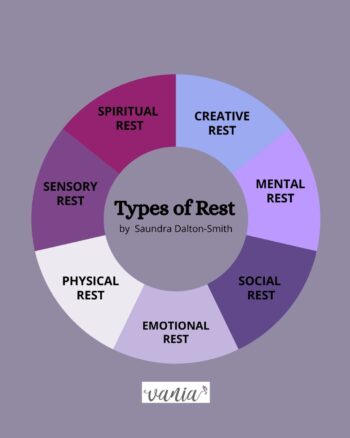
Dr. Saundra Dalton-Smith created a great model of 7 different types of Rest. I appreciate her perspective, as it helps us see what may be draining us, and what is the antidote. For instance, are you feeling over-stimulated? Maybe you need a sensory rest or social rest. Are you physically drained? A nap or early bedtime and NOT doing the dishes can be the perfect remedy. For me, it’s when i feel emotionally spent or mental tapped out that tells me what i need – a sacred bath ritual and time to myself.

I’m reading a hot new release called When Good Moms Feel Bad. It is a book that incorporates Internal Family Systems as a reference point for mothers. “The Inner Mother is your capacity for presence, wisdom, and care – qualities that emerge naturally when your parts relax and trust that you can handle what’s in front of you. This is the beautiful paradox of motherhood: in learning to care for someone else’s vulnerability, we develop exactly what we need to be with our own.” Jessica Tomich Sorci and Rebecca Gershan.

Having an Inner Mother is a visual reference of caring for ourselves as we care for others. It is not just practicing self-compassion, but the first preliminary step of tending to our basic human needs. Practising this attunement in our own internal landscape is a way of checking in with our Inner Baby (or child). All those things you’re already doing for your kids? They’re also just what you need. Whatever our children need, so do we. This is where our Mom Parts need to have a dialogue with our Inner Mother – The Parts have competing agendas. “The parts of you who work so hard to make you a good mom are the ones that are the meanest to you. Good Mom parts can tip you out of balance and into burnout.” (When Good Moms Feel Bad) Our Mom Parts want to care for our actual child AND our Inner Mother is the one tending to the child you were once upon a time. This can create an internal conflict when the Parts are polarized.

In Internal Family Systems, the model’s aim is to help us access ‘Self’ energy – the most evolved and integrated version of you. And yet, self-care continues to have a bad connotation. Unlike other self words like love, compassion, worth, and esteem, care assumes we are selfish. We are in fact, self-preserving (a hat tip to Audre Lorde). We need to reframe the concept of self-care as the care we give ourselves is aligned with our fullest expression. It needs to reflect who we truly are and not just the parts of us who give ourselves care like a checklist or a to-do list. The rest we give ourselves needs to be rejuvenating and replenishing our energy. It includes pausing by doing nothing AND also creates nourishment in doing so. Otherwise, what we claim to be rest is performative unless it also is nourishing.

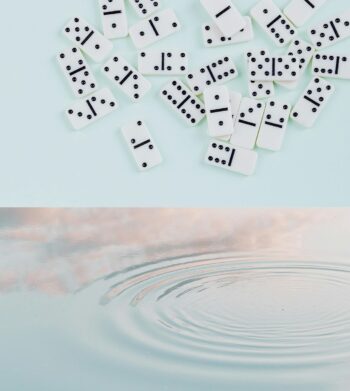
The word “self” in this term does not apply alone or only to ourselves. We are not meant to do the work alone. Otherwise, we are left always cleaning up the dominos that fall, being a martyr who people pleases our children, to avoid conflict and also because our own Inner Child is leading the decision. Instead, let us model what asking for our needs look like. We all benefit when we take care of ourselves and it has a ripple effect.

One great way to start to offset the overwhelm and exhaustion is to reclaim micro-moments of rest for yourself. Think of them as “reparenting” opportunities. These are mindful, intentional pauses that help you come back to the present moment. This is especially true when we go on vacation, and is a requirement of everyday life.

This means when we feed our kiddo, are we also checking in to see if we’re hungry? When you’re making your kids a snack, what if you made enough of it so you too could nourish yourself? And, when you ask your kids to come and sit down to eat it, you took your own advice and put your feet up? Or, the next time you wash your kid’s hands after school, take a moment to wash your face and slow down to apply some lotion on your hands and face. Breathe in the delicious smell of this lotion.

So often, women tell me that they make just enough smoothie or kale chips, breakfast or snacks for their kids to eat, but don’t consider their own basic needs. I am not exempt from this – i put out my kids’ vitamins while they eat their breakfast and totally forget my own supplements. They are RIGHT THERE besides my kids’, for goodness sake! Burnout manifests when we set impossible goals AND have internalized the belief that we are meant to tackle the load on our own. Being busy is not the same as being productive. Busy is a reaction to the tasks you have to accomplish whereas productivity is PRO-active and has a larger goal and purpose.

My kids are teens now and travelling with them looks different than it did when the were young. I may not be as touched out as i once was. Mainly because my kids are taller than me now – i have not held their hand in years. I still make sure they are close by when in crowds and ensuring the necessities are packed – like toothpaste, swim goggles, and phone cords. That mental load is a checklist i start writing down weeks before the trip. And while it falls on me now, it is a task i take to heart and is part of my mothering job description. My partner balances it with his own list and load – car rentals, mapping our journey, and learning about the history of the places we go to.

We might be touched out by all the work of motherhood. Maybe the burn-out we are feeling is in fact overwhelm due to our flawed society that still wants us to believe we are naturally meant to be caregivers first and foremost. The mental load we are carrying is not meant to be ours alone to hold. What we call our fault or guilt is our overculture’s false narrative pushing down on us to keep us too tired to make change. To keep us too busy to notice the system is flawed. We are not a failure – the patriarchal, white supremist system is flawed and failing US.

“May this shed a light on the crooked path of motherhood. Momma Zen by Karen Maezen Miller.

One of my favourite podcasts, Moonbeaming, had Amelia Nagoski on it to discuss burn-out from a feminist lens. It was great, and also used a magnifying glass to look at the burnout mothers experience. It’s worth a listen but here is a great quote that really landed for me: “Nothing is going to happen until more help is given.” Here, Amelia is referring to the need to ask for and receive said help, to not continue identifying with the primary lead parent / default parent tension.

We need to remember that postpartum resilience isn’t something that just happens magically in our DNA. We need to build the structures in place so we feel more supported. It’s not just babies that need to be cared for when they become, it’s also new parents.

Rest is whatever refuels us. Taking time to rest is what helps us attune back to ourselves and rebuild our connection to our own Self. When this gets to happen, we can re-orient back to our Inner Mother and the intentions we have as a parent. This is why it helps to carry our own Vasalisa in a pouch wherever we go, as a guide for the initiation that is motherhood. You can think of this as a reparenting reparative experience: We need to do the work to heal. Some things to pack that can help this messy transition into parenthood are:
🌀Having even one or two folks who are further along in their parenting journey as mentors or guides
🌀Reading the plethora of books that exist now more than ever before (but this also adds to mental load)
🌀Getting to visit with the other parts of us that are not connected to our mother role – this includes time to rest, play and be our fullest self when on vacation.
🌀Joining a group and being part of a village of supporting each other and being witnessed in this transition
🌀Ask for help – seriously do it, just call Vasalisa’s name
🌀This “hell” has a name – uninitiated parenthood – so learning about matrescence can lessen this feeling when reclaim it as a sacrifice and rite of passage

The hell is what you make it and it doesn’t have to be this hard.

Asking for help is a key part of meeting our needs as well as modelling that doing so is a sign of strength and part of being a human. We may not get our needs met or the request may not be fulfilled, and yet it’s worth speaking up for ourselves. Why? Well, because a take-away we experience is the truth that we matter enough to ask for help or support even if it can’t be given. This heals the wounded parts of us that remain present in our inner system. They get the gift of an unburdening and evolve into a more helpful agenda. It also helps us not hold resentment towards our own children for the freedom they have that we didn’t receive. We oscillate between anger towards our children and people-pleasing them, as ways to not repeat what was hard for us as children. Neither of these tensions heal our parts. Mainly because they have agendas that are polarized – one is advocating for our own needs alone and the other prioritizes our children because we are afraid they will also feel unloved otherwise.

Remember what i mentioned above, about our “parts?” Our real-life children are not here to heal our unmet needs from our childhood, so cannot heal attachment wounds. It is our responsibility to ensure that the children are taken care of and that’s what we also need to learn how to care for our Self – to soothe her so that we don’t repeat what we inherited.

A tremendous amount of healing comes from loving ourselves through motherhood, and then witnessing the gift of our healing as it is shared with our children.

And, in case you don’t believe that we model what we need with our children, here’s a funny story that may help. My daughter had a dance recital and when the teacher asked the students what something they need to do this weekend, after the answer is, I’ll take a bath or have a nap my daughter said “ask your parents if they need help.” Not only was I beaming with pride and excited that she knew that and said that answer, I was also proud that my kid was the one that reminded everyone that we all need help, and our kids are members of our home environment. For the record, we are not asking them to take over the adult jobs, but to contribute and to learn how to care for things so that they will know how to do it one day. They also need to know that we are also not superhuman.

Witnessing my daughter say this helps me trust that my kids know me and what I need, at least in theory. So when i heard her say it, i exclaimed with joy “that’s my kid!” She came up to me after and told me how much her friends loved my excitement and called me an icon. That is a win!

So, the next time you travel, feel overwhelmed, and need to rest, make sure you remember to ask Vasilisa for help! You are never alone.

The Ever-Changing Growth and Development of Children

My daughter’s class is about to start their lesson on puberty at school. I know this because she told me and the teacher sent a heads up letter. So I was able to look through the curriculum and appreciate some of the topics. It covers themes from anger management and stress reduction tools, healthy relationships and learning more about how the body works.

This info is not new to her. At 10, she already knows about puberty, menstruation and how her body will change soon. Her body is already changing – she has small breast buds, tiny new armpits hairs, and a new awareness about herself. We’ve had some great chats at home about the body and how it works. Both of my kids know what menstruation is, and what i use when i bleed each month. We have talked in child-friendly ways about abortion. Read this old journal article to get a sense of this. We use the ‘proper’ terms for all the body parts. And now we are entering that territory where it’s not just theory and information but actual embodied understanding of it.

My son is on the cusp of puberty. He’s grown in all directions this year, and his body is changing before my eyes. I have never been a 12-year old boy and yet i know I’m the adult in his life who will talk about this the most. Sure his dad will play a key part (especially about wet dreams and how to take care of his penis), and i know we will have talks about relationships.

Because we already do. Because this is an example of how I work as an matricentric feminist. Motherhood is a Hero’s Journey. It is a shapeshifting alchemy that forever changes us, hopefully for the better. But the change it gives us is inevitable. This beautiful book by Lisa Marchiano has been keeping me company these past several months. In it, she shares fables and stories of the sea change impact of motherhood on her clients and herself. She also uses the analogies of old traditional fables to help us see that this is a universal journey.

It’s going to me who shapes his understanding about how to be a good friend and partner, and how to be comfortable in his body and find was to access pleasure. Not because i’m a mom and woman and this typically falls on us to do, but because this is a big part of my work and life’s mission.

My passion is to help others attune to their body and embody their pleasure, from an embodied place.

I can’t wait to have my daughter talk about this more fully as well. I was 9 years old when i got my period for the first time. It was the summer before grade 5 and i had no idea what it was. I thought i hurt myself outside while playing in the backyard. In grade 6, there were a couple of girls who had it and we were already started to form mini breasts. I have known most of my life the power (aka attention) i get for my breasts alone. For many years, it felt more like an alien invasion.

Now that my daughter is 10, she’s older than when I first started my menstrual experience. We can’t wait to celebrate the transition into puberty. She told me how she and her friends were talking about being embarrassed about this transition and I heard her tell them that she knows I will be honouring it with a rite of passage celebration.

It’s important to tell our children about this important step in their journey in life. For me, this especially honours the journey towards womanhood. So we need to tell them your war stories around bleeding through your pants and explain the changes that happen in the body. We need to prepare them and also be there for those stories of their own.

I now feel connected and proud of my body as i have journeyed to a place where i am aligned with my feminine side and connected to it. For many years, the feminist in me went through many iterations – i was unsure what kind of feminist i was, and mainly how i dressed to showcase this identity.

One thing we’ve done as a family is normalize this as much as anything else in their lives. We have books and regular conversations. We watch shows and have a great dinner time conversations. This is a work in progress and i wholeheartedly believe that we do not have just one talk about ‘the birds and the bees.’ Rather we have several over time, and again and again as our kids get older and can take in more.

Speaking of books, here are some that I have found to be really great and wish they were around when I was experiencing this transformation. My kids keep some right beside their bed. And i have totally caught them reading them. In a good way, of course, not in a shaming way. That is so important to me. The puberty books i knew of as a kid were hidden away, and i could never ask my mom to read them.

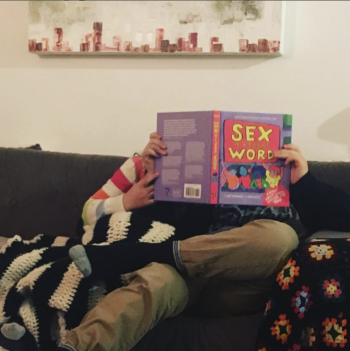
*Sex is a Funny Word – i can’t wait to read the newest one by Cory Silverberg and Fiona Smythe!
*Celebrate Your Body and It’s Changed: The Ultimate Puberty Book for Girls
*It’s Perfectly Normal
*Puberty is Gross but also Really Awesome

I was already planning to write this article. Now i had to finish it. The timing of it is magical: Now the States have decided to possibly not allow abortion. These are conversations I’ve had with my children. In fact I also spoke to my son last week how I felt about this decision. He heard it and we had a pretty inspired conversation about it.

Learning about puberty, sex and body autonomy is so important. We cannot let anyone in power dictate what is true and real about our bodies, and what it is our right. My kids may be a bit embarrassed and yet they still come to tell me. That is the path i wanted to create for them.

My Daughter is a Fawn

Last year, on one of my escapes from the city during the pandemic, i came across a baby deer. It was truly a magnificent sight. We locked eyes for several minutes. I tracked its posture and racing heart. She stayed perfectly still, trying to blend into the forest floor she had been napping in. She looked so much like the depiction of Bambi that i thought i was making her up.

As someone who has been immersed in trauma therapy and continues to train in the area of somatic therapy, using our animal friends as reference is commonplace in therapy trainings. I have watched several videos of various animals following their survival instincts, as a lesson to see how humans also react to stress or fear-based moments in a similar way.

Most of us have heard of the concept of “Fight or Flight”. It is something that i have written about here several times. This past year, even more of us have heard of Freeze and maybe even Fawning. Well, this actual fawn did not fawn to me, or presumably its mama that was most likely close by. She froze, or rather feigned dead. She stayed perfectly still for several moments, tracking me with her eyes, nose, ears and surely a 6th sense. When she saw me whisper to my partner (who was able to witness this beautiful sight and therefore vouch for the authenticity of my story), she took that moment to Flee. Maybe she ran to her mama, but i could see no other 4 legged creature nearby.

We can learn a lot from our animal friends. In truth, we are not that different from them.

Take my daughter for instance. She has perfected the art of a good compliment. I’m not exactly sure where she learned this as she’s only 9. She will do it to just about anyone. I think it’s a wonderful trait as it softens people and she sees the humanity in them. Even today, on our first adventure to the world of shopping after a long term lockdown, she complimented the cashier on her shirt. It was a cool shirt – a classic Empire Strikes Back retro tee. It led to a long chat about our favourite Star Wars characters and why. My daughter knows how to break the ice. She’s social and extroverted for sure. She also is good at connecting with others. This shopping trip was surely in the area of a safe and relaxed outing, so she was happy and relaxed – in a Ventral Vagal Part of her Nervous System. But she does this too when in conflict with her family – this is where the fawning comes in.

The other day, we got into a conflict over doing a chore that i asked her to do several times. This is a pretty typical argument, and yet i was not as regulated as i’d like to admit (i’m a human first, mom second, and then therapist after all). She picked up on this – co-regulation and neuroception goes both ways. So, she complimented me on my 15-year old bathing suit that i was wearing at the time. To be fair, i love it too and it is a gem. But, i knew she was doing it to stay on my good side, and to feel safe. My partner called it manipulative, but i now see it as Fawning. As a younger child, she used to do it more physically, with running to us for cuddles, or being close. Now, as a very articulate and socially aware young human, she has a deeper sense of co-regulation and helping clear the air. This is where appeasing the other person comes in.

To be clear, my daughter lives in a safe and loving home, with parents who are present and attunement, albeit re-parenting their own wounded parts (some that were activated during the pandemic). Her instinct to appease is not because she is in harm’s way, but rather how her body responds to stress she takes in from conflict. It is in her DNA and Nervous System level where the instinct comes. In other words, it’s not her, but her nervous system responding for her. All creatures, humans included, have this instinct to survive under duress be it fight, flight, freeze or fawn.

For the record, my son is a Fighter and I’m a former Freezer. Plus my daughter also plays a role in starting a lot of fights. There’s an inner fighter in her too. As a feminist mom, a part of me is relieved. But that’s a story for another time.

In some children, this instinct is definitely linked to a stronger need to survive.

In childhood, where most of these survival instincts start to form, children who fawn learn to put their own needs and feelings aside as it feels safer to appease the other person. For anyone who grew up in an abusive home environment, fawning is used as a powerful safety strategy and survival skill. Children learn quickly that saying ‘yes’ is safer than saying ‘no’, even if it goes against their own wishes. Self-sacrifice and people-pleasing becomes the default to stay safe, even when there is violence present. Repressing their own needs becomes an adaptive strategy to de-escalate any further potential danger.

When it’s used time and time again to diffuse a conflict, the body stores this default and people-pleasing becomes a maladaptive coping strategy. As adults, our body remembers these acts of appeasing or fawning, but our cognitive brain struggles with connecting the dots.

How I might respond to someone and fawn is a way to keep myself safe when I feel in conflict. For instance, I recently noticed myself fawning in response to a potential conflict with a neighbour. While the details are irrelevant here, it was only when i was reflecting with my friends later did i notice my instinctual response. My need to be safe and people please over-rode my own internal felt sense of knowing we were not doing anything wrong. I avoid conflict and yet have had to deal with it firsthand many times. As a child and youth, i definitely had a fawn response to conflict. My go-to fawn response to conflict with others is something that i have been working on recently. This is especially important in unpacking my own white privilege and internalized stories. Looking back, it reminded me of a recent newsletter article by Rachael Maddox (if you don’t already know of her wonderful work, this is your chance). She spoke about the difference between humility and fawning. Humility is about acknowledging the humanity in everyone involved, with sovereignty. Fawning is the instinctual motivation to be safe when we are afraid to cause harm, and it doesn’t inherently provide space to grow trust and collective healing. Reflecting on this, it showed me again how the two concepts are two sides of the same coin, showing up based on where i am in my nervous system regulation and how my vagus nerve is tending to me.

There has been a lot of talk in the therapy world about the concept of ‘fawning’. Cathy Malchiodi wrote a powerful article recently, using a feminist lens to unpack the inherently sexist connation of the term. New words have been created to speak to its truer meaning. Appeasement, fitting in (a slightly different practice actually) and now Feigning. I do think that there is a place for fawning though, as i have seen and felt it firsthand in my own children. I am not entirely sure if the Fawn response is gendered, and yet it is girls who are taught the art and reward of compliments, as well as finding cuddles acceptable. There may be an inherently internalized sexism at play. It might come from our own mirroring. I do know that these 4 F’s are nervous system instinctual responses, so there is no thought to it.

Connection, attunement and co-regulation are necessary for all creatures. Being close to others is a safety resource and a right (thank-you to Polyvagal Theory we get that info now even more). I don’t want my daughter to stop her desire to connect to others. She has remedied and repaired a lot of conflict with her fawning and quick bounce back. In fact, she is pretty good at repair for a 9-year old. For anyone actually. And i do know i need to support her in her need to fawn. So this change starts with me – scanning my response that might make her fawn in the first place. It’s hard work to be more regulated with a child who has pushed my buttons time and again. And yet, no one said parenting is easy.

This is tenfold when you are healing your own trauma alongside parenting.

So many of us may be starting to see the toll people-pleasing, fawning, and fitting in have on our our self-agency, autonomy and sovereignty. But don’t worry, there are ways to start to heal this survival strategy.

To start, it is very helpful to learn more about your own Limits and Boundaries. Ugh, i said the word Boundaries. Yup, they have a lot to do with healing our Inner People Pleaser. Play with your invisible moat – how close can people get to you physically before you start to feel like they are invading your space. In a world healing from the pandemic of Covid19, this practice is especially timely and poignant.

Fawning is very connected to that felt sense of ‘walking on eggshells.’ This is where you know that there may be an imminent explosion and your instinct is to de-escalate the situation by sacrificing your own needs or people pleasing. So, track your body’s response – put your arms out to see where your border is for instance. Follow your heart rate, tension on your legs, or tightness in your shoulders. Sometimes we don’t catch our survival response until later. So, use some time to reflect on what happened. Can you track your body’s response at the time? Think of what could have happened if you didn’t try to make this right, or manage other’s responses to you. What would happen if you expressed a disagreement openly?

Before answering a hesitant ‘yes’ to someone’s request of you, take a Sacred Pause. Breathe out a slow exhale (think of a breath out 1-2-3) and then see if you can access a gentle but firm ‘no.’ That exhale activates your parasympathetic nervous system and vagus nerve – the shift from a reaction to a more intentional response. It relaxes your body from going into fight or flight, which can spawn the drive to fawn.

Take some time to reflect on your journey with fawning. This may be a hard exercise so notice if you have capacity for it. Tracking a narrative timeline is a helpful way to also show that your survival response did just that – helped you survive. It may feel counterintuitive to thank it, but showing gratitude for the Part of you that helped you survive is so healing. There may be a younger version of you that just wants you to know that you are grateful and working on healing any self-hatred or shame that may be attached to the trauma you endured. Remember, you did not deserve the pain that was caused you.

Now moving into your present, think of some people in your life who honour your boundaries, who respect you, and who value you for who you are. When thinking of them, what sensations do you notice in your body? Is there any soften that is more accessible, are you breathing deeper, or maybe your shoulders drop a bit and are more relaxed. If you cannot access a person who honours this, think of a pet, or take some time to watch some movies or TV shows where you can witness characters having this healthy boundary practice. This exercise helps you access your social engagement system where your Ventral Vagus Nerve thrives.

I think we also need to do an about-face with being nice. It presents as less threatening for sure, and can de-escalate conflict. But to what end? I know i have been nice more times than i want to admit, and it’s my own self-worth that paid the price. I kind of love the acronym of being a BITCH – a woman who Believes in Taking Care of Herself. We need to reclaim this word as patriarchy as stolen it from us, like so many things. I am sick of being the nice girl who is trying to soften any possible conflict, be minimizing my own needs and worth in the process.

Treat your skin like the border it is. Notice how your feet ground you, how you hands can honour the distance you need from someone else. I bet you have been tracking what it feels like to wear a mask these many months! In the next week, walk barefoot outside and see what sensations is brought for. Nourish your hands as they hold you in resonance. Get naked in bed, just to feel the sheets on your skin directly. Track your skin’s sensations in connection to your stress of safety response. Think of pins and needles, or that sensation that awakens in the back of your neck. Skin is there to help you track your interocetpion – your response to others. So also make time to show it love and attention. Give it a gentle massage or lotion to savour. Show it gratitude.

One final tip is to orient yourself to your physical space when you feel unsafe. I love the somatic resource of Orienting as it helps me titrate the feeling of unsafe in my body. I either give myself a self-hug and say ‘shhhh’ as a way of self-soothing, and relaxing my body, or i look at an item in the room to orient to outside of myself – this is called Proprioception. When i locate something, be it my favourite photo, a bouquet of flowers, a candle, or something that is my favourite colour, it helps me start to relax a bit. Then see if you can take a deeper breath and honour your need to say no or hold a boundary.

Remember, the Shadow side of connection is Fawning. When we are in our Window of Capacity, we can access that need for connection in a healthy way. Fawning is just one other way to get that need met, when there is dysregulation. And yet we are social creatures who thrive in community. This past year has complicated our relationships for sure. Now that we are in a semi-post state of the pandemic, it helps to notice what your body is telling you as you start to make you re-entry into social life.

I’m a book lover and find community in the books i read. This is a good resource for learning oure about healing your Inner Fawn as well as perfecting a boundary practice. Kimberly Ann Johnson’s book Call of the Wild: How we Heal Trauma, Awaken our Own Power and Use it for Good does a wonderful job unpacking this more. She also has a course called Limits and Boundaries if you want to reclaim your rightful boundaries.

Prentis Hemphill has a beautiful quote that is so fitting here: “Boundaries are the distance at which I can love you and myself simultaneously.”

Exactly.

Perfectly Imperfect Summer Vacation

Today marks the End of vacation mode for me. We were supposed to go to France the first 2 weeks of summer vacation, in honour of 20 years together with my partner. It was to be the first major trip for our family and the honeymoon I never had. While that’s not what ended up happening (thanks Covid!), we did a get an extended cottage break outside the city.

I’m not ready to go back to the city just yet. We’ve been away for close to 2 weeks and it’s been the break we all needed. It’s not France by any means and yet it was the remedy for some hard months.

Here are some of the things i will hold on to:

I swam daily, sometimes more than 3 separate times

I paddleboarded quite a bit and saw the bottom of the lake

I read 3 books while here and am onto book 4, #12 since the pandemic started

I found an abundance of new heart rocks to add to my collection

I saw my parents for the first time since February

I was creative – I sewed, played with clay, and knit a new summer sweater

I slept with my children, as we played musical beds as we would on a vacation

I had mindful moments watching butterflies 🦋

We had family time – in the water, which has always been our salvation, video games and we watched the whole first season of the new The Babysitters Club show

I lead my kids through some witchy classes to give them some routine

I saw the full moon and said hello to the stars most night

I sat in my beloved Donut Donut

That may sound like perfection, or at least an easy vacation. But of course, travel with kids is never that. Anywhere you go, life gets in the way.

Of course this time away wasn’t perfect and there are things I’m sad I never got to do. Maybe my expectations weren’t realistic, and some things were out of my control.

So….to keep it real:

Our yard in Toronto is a small square and we have so much green space here but we never went for walks in the forest.

I only did yoga once and only then because my back hurt too much so it was more for necessity

I never slept well until the last night

I didn’t journal once

My kids still had epic fights and there was some family yelling

I made a huge mistake in the romper I wanted to sew

My parents only stayed for a quick visit even though this is their space

We didn’t play any board games as a family, and we brought several from home

And I only read in the hammock once, because my kids needed me more and this time away was about attuning to each other.

I share both sides because we are prone to compare ourselves to others, making our side the deficit. I know I’m incredibly privileged to have access to an oasis during a heatwave. And ever, for that matter. I also know that I wasn’t able to truly relax into it. I worked still and so did my partner, still had to manage the kids needs, and the dishes were never ending.

One thing i noticed only in retrospect is that some of my expectations were of times past. So while realistic as a teen or twenty-something, now with young children of my own, going to the cottage means something else. I can definitely swim and read, but not for the hours of end i grew up doing. No wonder i was a bit disappointed – my expectation was just out of the realm of realistic.

This is every day life after all, pandemic or not. Vacations are just as imperfectly perfect as every day life and they don’t escape the “full catastrophe” of living.

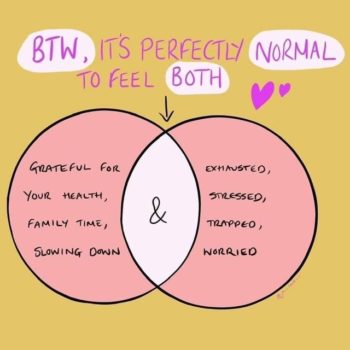
My son is having a hard time holding on to any good moments. We review each day at bedtime, helping him notice that there were moments in the day that were good, even during a pandemic whhen his life was thrown upside down. I’m not suggesting to avoid the hard feelings, as I’m not a positivity cheerleader. And yet, when we can hold space for BOTH/AND experiences in our body, we allow more space for good feelings. This is Titration and helps heal us when we are going through hard things. It makes it easier to go through it when i know i can also feel good in a day, even for a few moments.

So, instead of focusing on the hard part of life, it helps to notice moments of joy. Our bodies can relax and get a handle on the hard. In a few weeks’ time, when I’m feeling overwhelmed, I’m going to recall this time away. I’m going to sit and breathe in the sounds of the birds chirping, or the cool lake water on my feet, or the grass under me when i read a book. This intentional practice will let me body relax and sigh out a bit more.

I am a bit nervous about regular life as this summer looks so different than usual. So when i need a boost of joy, i will feel the sun on my body, some shared giggles and slowing down these past two weeks: I’m as ready as I’ll ever be.