
I am just back from a vacation of a lifetime with my youngest. It was our first ‘just the two of us’ trip. It was to honour her passage into high school, and so l gave her a girls’ weekend at a favourite city with all the perks of a city that never sleeps – shopping, good food, and lots of selfies.
This summer has been all about marking this developmental transition of adolescence. My big kid was home alone overnight for the first time, we had our first parents-only camping trip, and both kids got a big trip with just one parent. This is us honouring what is ending and also becoming. And, i don’t mean what is happening for our kids. We too as parents are in a transition season: The end of school-age parenthood needs to be honoured in ceremony. It may not be a major life transition but it is still a rite of passage.
I’m glad i’m not alone in wanting to honour these initiations with some type of pomp and circumstance. I’ve been watching the show Sterling Point with my youngest. It has been such a good bonding opportunity as we watch certain episodes, stories, and themes. We have a cottage near the location so it’s an added bonus to watch the show from this vantage point. One storyline that i loved was how the group celebrated Maple starting her menstrual cycle. They made her a flower crown, howled like wolves, and shared advice. I had a ceremony for my daughter when she started her menarche. At the time, she was not as into it as i am, so seeing this portrayed in the show was really exciting for me. It normalized ceremony as an important part of growing up. If you want to see my hot take on the show as a therapist and mom to teens, take a look at my recent instagram post.
In the coming weeks, both my kids will be in high school. This is a pivotal rite of passage for me as well as my youngest kiddo. It dawned on me only a few weeks after school ended that I need to honour the rite of passage for myself. It was our last year at the same tiny alternative school both my kids started at when they were a mere four years old. She celebrated the end of an era for herself. She had a party after-party, and got all dolled up. As much as we honour commencement and ceremonies for our kids when they’re moving through different pivotal stages of school, we also need to have a way to mark this for ourselves. And so this is something I’m noticing I need to do as my youngest starts high school.
And so, I am working on crafting a ceremony for myself to honour the arrival of high school. I need to mark this transition for myself, and i suspect other mothers will gladly participate to honour this threshold for themselves too. Plus, i am always looking for a good reason to host a ceremony.
It is time we brought back more ceremony into our lives, and less superficial celebration.
A rite of passage is not just celebrating the transition. It is needs to include some work and letting go. It needs to honour what is ending and also offer a bit of elbow grease. Marking it in this way offers the somatic experience of The Return, the coming back but anew felt sense. In Arnold van Gennep’s Book, Rites of Passage, he shared that this step is key and often overlooked. Having time to to integrate an experience is as important as embarking on it. We may not go on pilgrimages as a society anymore (though i definitely advocate for one) but we can practice a modernized version of a quest. It might look like a camping week, a portaging adventure, a summer work experience, or a trip.
Maybe not the most fancy of activities, but one thing we did was request some household projects to be done by our kids. As part of my teenagers experience for the summer, we had them do a few tasks and chores around the house. Some of things that they’ve never done before. And so when my eldest was sanding down the deck, I noticed they were sitting on our rickety outdoor dinner table. I asked them to not sit on it because it was precarious. They grunted and complained and rolled their eyes at me, but stood up. An hour later, they came up to me with the invisible tail between their legs and admitted that they sat on the table again and it cracked.
The moral of the story isn’t that they did the thing I told her not to. It’s that they felt safe to come and tell me they did the thing and knew I’d be upset and possibly even say I told you so and they still came to me because they couldn’t fix it alone. They trusted that even if I was angry at them that the love was always going to remain.
This is what I want to happen if they were ever to do anything out in the world that made them feel scared or in danger: To call me no matter what.
As the saying goes: Small kids, small problems; Big kids, bigger problems.
Raising a teenage daughter today is a modern-day version of the myth of Demeter and Persephone, but the lure is social media and not Hades. Or maybe social media is the new Hades, in a more modern trickster suit. I’m fighting to keep my daughter close but I am competing with a greater force and that is her phone. I’m not fighting my kid about her phone, I’m fighting the attention the phone takes from me. Our smartphones were supposed to be a place we sometimes visit, not a place that we live in all the time. This is my work-in-progress project. As my teen enters the high school jungle, i know that i need to hold onto her a bit more. My grip may not be as tight but it needs to remain nonetheless.
I’m needing to do that consciously and not reactively, so that I don’t fall into anxiety and instead have a clear path that helps me stay clear and secure. I need to also do this in a way that doesn’t lose myself in motherhood as I enter my new Virgin territory.
Many of us are raising children and being parents as an over-correction because we were raised by parents that were emotionally immature or unavailable and so we want to be the most present, attuned, available, and understanding parents to our own children now.
I remember having fights with my own mom about my friends, how long i was on the phone at night, and our competing needs. Now i see it as normal teenage woes. Back then, I grew up being told by my mom “wait until you have a teenage daughter. That will be your karma.”
Maybe it’s not revenge that my kid is giving me a hard time. Rather it’s destiny as a developmental stage. Teens are meant to protest as a way to build individuation. I know this now. I also now see that my mom may have been going through perimenopause at the time i was a teen, and i really wish this was spoken about then. I get back to this point soon.
A part of healing these parts was to first unlearn that anger is scary or destabilizing so that my children can embody it more fully.
I have internalized a wound of unprocessed anger due to ongoing unmet needs, and it is what is fighting with my child at this developmental stage. What i couldn’t say to my mom back then is hard to hear my kid say to me. It’s not karma that i have a sassy kid. It’s a pattern that has taken generations to get to me, and i can now heal what wasn’t repaired. My own Inner Sassy Teen Part is very headset on being able to say what she needed back then. My Mother Parts need her to remember that my kid has her own needs now.
Our teens also lose the mother that they had as a younger child themselves. Gone are the play-based days, the years of wonderment and mini-me dress up. We must grieve the end of that chapter, so we can accept and birth this new one that evolved from it, and also offers more depth and closeness in the present.
Matrescence is the adjustment period to motherhood, and I think this initiation of becoming a mother to teens needs its own great passage or marker so that we don’t step into it unconsciously or uninitiated, but rather with our eyes wide open. I thought i was moving out of the stage of motherhood, only to realize that it is more that i was moving into a new stage OF motherhood. I was getting excited to claim the identity of Mage/Queen/Virgin, but i am not there yet: I may be perimenopausal and i am still mothering. I’m a baby mage, eager for this new stage of life but it is not yet where i stand.
I’m still crawling.
I am one of the mothers now who are in perimenopause while my children are in puberty. We are not supposed to be at these intersecting stages. In a recent issue of Hot Flash Mag, Jessie Harrold says it so well: “Here we are losing that biological wiring to nurture, and our kids actually need more from us than they probably would have for our foremothers. So there’s this real tension and conflict. The mothering I thought I was going to be doing at this age is very different from the mothering I am doing, which is far more intensive.”
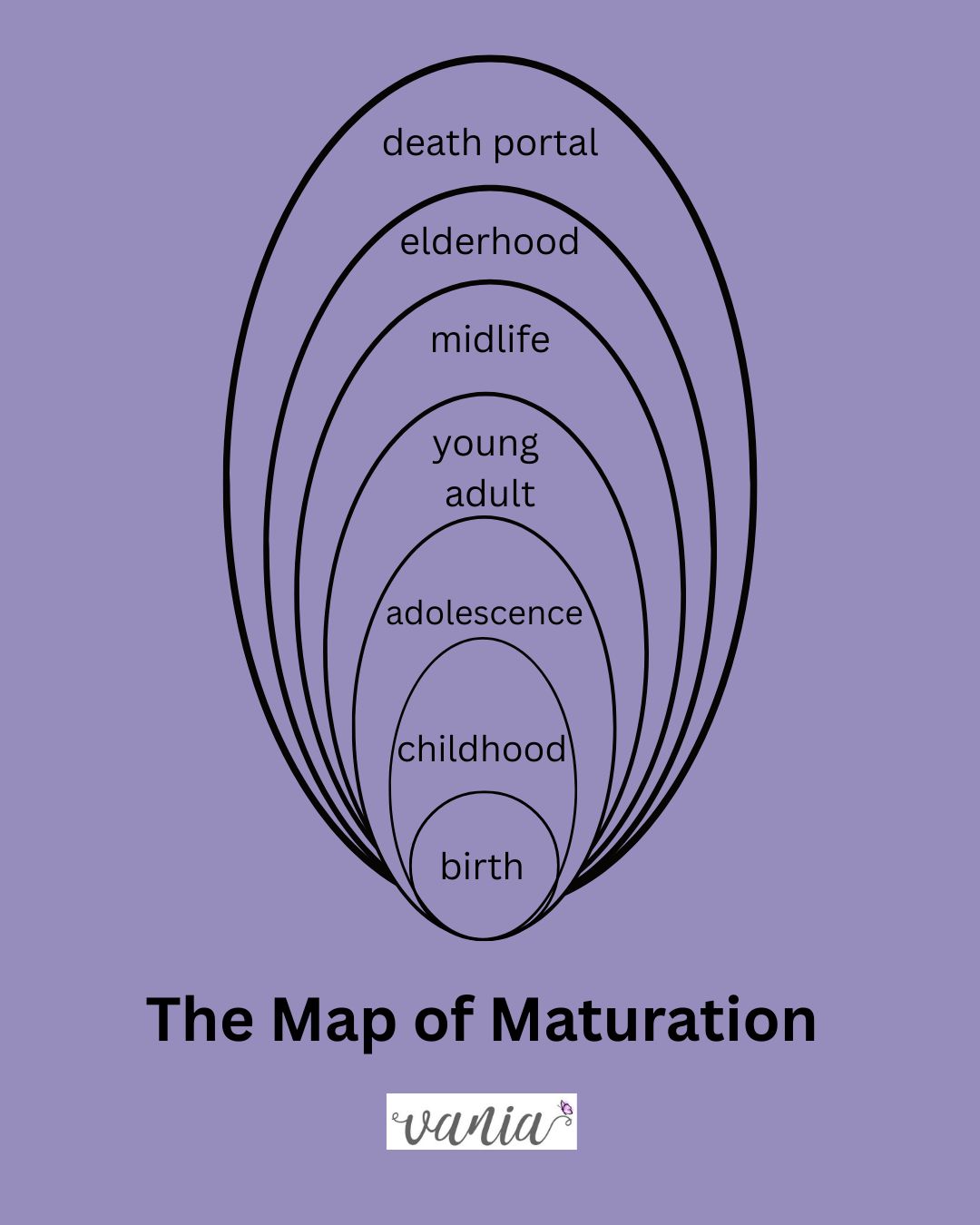
A part of the becoming that happens is that we put on a new suit as advocates and mama bears for our children. No one‘s going to have our kids back like we do; even when we say no to our kid it’s because we have the best interest for them in mind. The tension is that our kiddo may not see it that way, and we need to stand our ground. This is where the messy hormonal conflict can pay a role, and be a toll on our connection. I need to remember my role as a parent is to guide my children to their fullest potential, to grow and evolve, to reach maturation. For this wisdom, i thank Gordon Neufeld.
Parenting teens is learning to embrace your new role as the lighthouse keeper. You are now watching from the beach. You are close enough to touch them, to see and hear them and just enough distance for them to find their own way. In Kim Jon Payne’s book, The Art of Discipline, he offers another theory – the 3 stages of Parenthood – the Governess, Gardener, and Guardian. I am embracing the newly minted Guardian role. It is a time of becoming the guide for my children, not activity playing or weeding like i have been.
 Whenever i get a bit lost in the waters of motherhood in modern-times, i come back to my anchor, that is remembering my role as a mother. In their book, Sil Reynolds (now Read) and her daughter Eliza, Mothering and Daughtering, offer us some insight and guidance on how to move through this messy stage. To start, Sil shares that “Mothering” can be seen as a verb, the action of helping our children become the adults they are meant to be. She also offers that we need to incorporate intentional quality time together – like my big trip with my kid and watching teen dramas together. It also serves us to understand counterwill and learn to read our child’s cues. This has been such a life saver of mine over these last few months. And it’s still a work-in-progress.
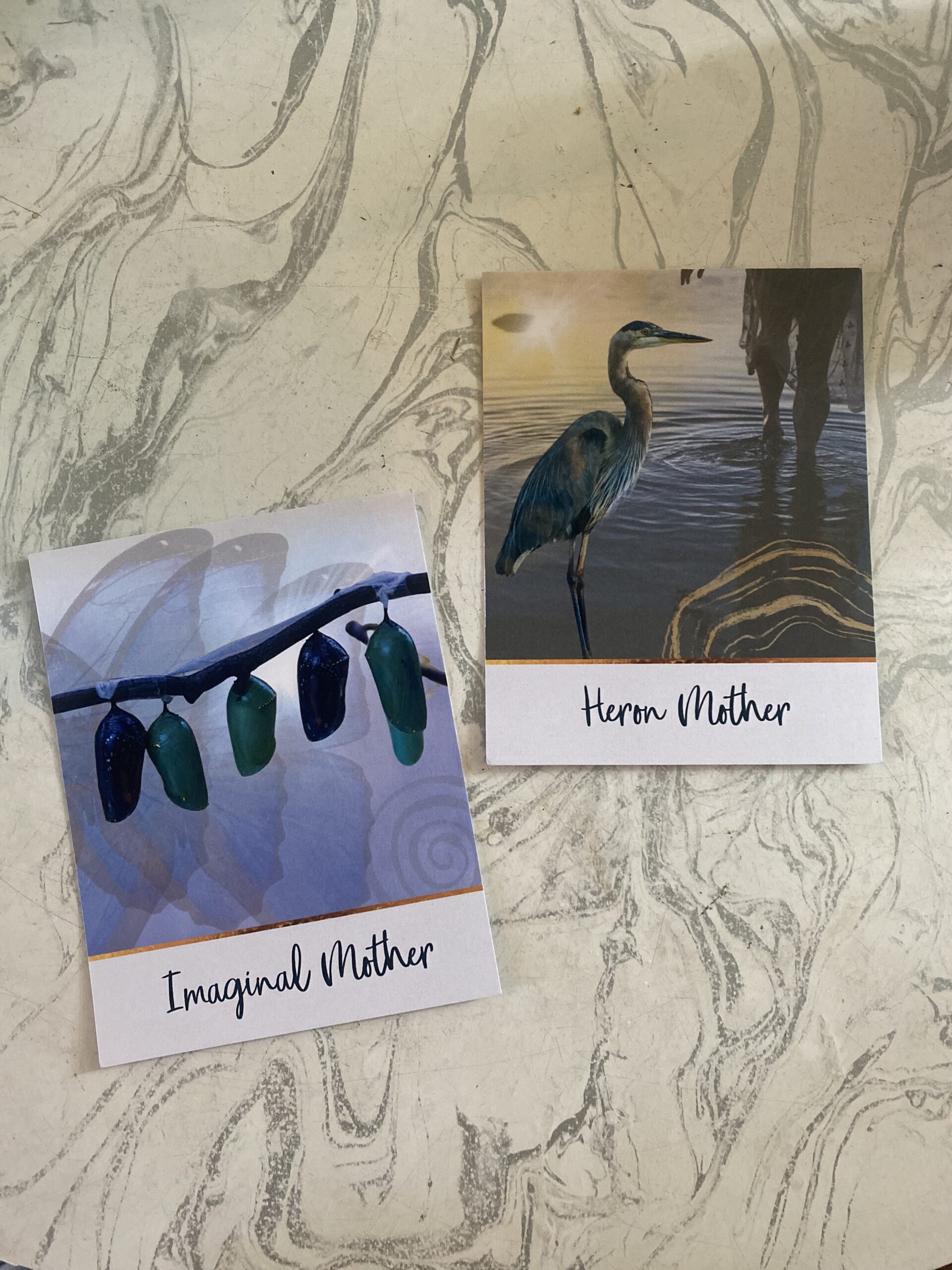
I was recently gifted a beautiful deck of cards by my friend Jessie Harrold. She wrote the wonderful book Mothershift, which is a guide through matrescence and finding our north star as parents. This deck is a visual reference that helps us see what kind of mother we are at a specific moment in time. I am no longer the Crafty Mom or archetype. According to Jessie, I am the Heron Mom: I am walking the threshold between who i was a mom and who i becoming. That means i need to trust the magic and also grieve what is no longer true. I can feel the pull of the Imaginal Mother who is becoming who i truly am, but it will take time to mothermorphize (a word Jessie and i made up) as my kiddo has to adjust to being in high school herself, first.
Speaking of getting lost in the waters, one thing i do when i feel like i’m drowning in unfamiliar waters is to seek out who has been here before. This new terrain of mothering teenagers may be new to me, but i am not the first parent to do so. This is not uncharted territory. Ideally, this is where mothering mentors come in. I have found some older mothers in my life that i can turn to at times, but not consistently or for the actually themes i need support in. Since we live in a society that is void of true mentorship, i have to turn to some other guides. Folk tales, myths and the timeless stories of our ancient ones and ancestors.
And, for me that includes looking at mythopoetic stories that depict motherhood in universal time and space. It’s a good thing that there are many examples. One of my favourites is the story of the Greek goddess of Harvest, Demeter, and her daughter Persephone. It is Persephone (or Kore’s) journey to the underworld and her mother’s grief of losing her daughter that we can thank for our seasons.
What i have also found is that the story of Persephone as many variations. For instance, Carolyn Elliot shares in her powerful book, Existential Kink, that maybe Persephone’s journey was in fact subconsciously manifested by herself as a way to integrate her shadow parts and becoming whole. We need both our conscious and unconscious parts to complete us after all. And maybe, Persephone’s flight to the underworld was her way to get space from her over-bearing mother. Maybe she needed this time to find out who she was. So she rebelled and flew the coop (like i did at 16, incidentally). This allowed her to find herself and integrate the tension of opposition and reliance, struggle and ease, independence and connection. And Demeter herself had to reckon with the truth that her daughter needed to find herself separate from her role as a daughter. I like to think that Demeter had to grieve losing her daughter as a maiden in order for her to find herself in mid-life as a woman herself, and not just her leading identity as a mother. In her acceptance and surrender of Persephone’s individuation, Demeter was initiated into Virgin Mother territory – a woman who belongs to herself first, who is whole unto herself and who has the qualities and strengths of a Mother. She no longer puts her needs last, she models that having needs is not only okay but a part of being human. In fact, it is through her practice of caring for herself that she is paving the path for her child to reach individuation and maturation herself.
So maybe the story of these two goddesses set the stage for us all along. Maybe they carved a path for us to follow but we forgot that Persephone needs to find herself on her own, and we are meant to grieve what is ending – not the relationship but itself but the duties that came with it change over time. Grief means needing to say goodbye to what was in order to become anew and also find our new meaning. Maybe our modern-day experience raising daughters is not that different than Demeter and Persephone’s. What offers me solace is that it is just a stage and Persephone comes back. When we trust this, it makes the grief in Winter tolerable.