A Mom’s Mental Load: Carrying your own Vasilisa Doll

I just got back from a vacation. My first beach holiday in years. It was to honour my 50th birthday, not as a break from life. Yes, i wanted to slow down and relax, just not to escape my life. Vacations are not meant to to get a break from our everyday life, but to enhance it with a dose of pleasure and adventure. As a global citizen, this is also a privilege to experience other cultures and learn from their wisdom and experiences. The way I do them is to infuse intention, ritual, and soul tending in my time away. If we assume a vacation is going to cure burn-out, we will be grossly disappointed. This is especially true for a week away. If we view a holiday like a personal retreat, that may help. We do also need to integrate the time away into our life. Otherwise, the trip becomes redundant. It becomes a stand-alone event, forgotten quickly.

As a mother, a holiday is especially not a vacation from life. In many ways, it is more work, just different. Mental load, decision fatigue, and overwhelm with less resources play into what gets packed in our suitcase when we travel. Sure, we get a pause from work and that undivided attention to our family gets the front seat. It takes a lot of self-love and will power to also remember we are also on this vacation. Otherwise, we as moms continue to not be seen or heard.
Speaking of which, mental load is not a task itself, but the ongoing running to-do list that never ends. So it’s not so simple just to give part of it to someone else. They also need to start to take on the load that is unseen. We need to move away from the internalized Super Mom part that weaponizes our competence at the same time as challenging our partner’s incompetence. It’s not that they can’t do the work; it’s that it is benefitting them to not have to do it, yet.

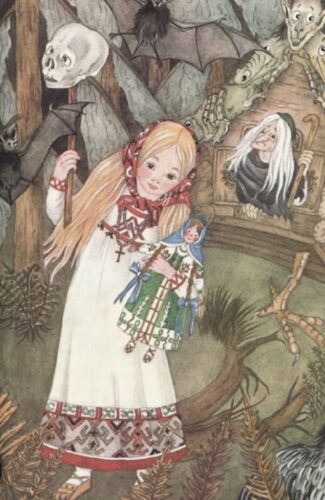
Do you know the story of Vasalisa and her doll? It’s part of the much larger tale of Vasilisa and Baba Yaga. One of the most powerful take-aways for me was that Vasalisa had what she needed all along. If you haven’t read the story yet, you might get some spoilers here so run to get your own copy of Women Who Run with the Wolves and then continue reading.

If you already know of the tale-as-old-as-time story, or don’t have time to read – because truly who does anymore, and that is part of my point with this exact article – continue reading and i’ll play the role of Vasalisa’s doll for you…

Vasilisa was a young girl whose mother died after a long illness. In the final days of her life, she made a small doll that was infused with magical qualities. Mainly they were acts of service that helped Vasalisa during times of struggle and initiation. These acts were what a mother does when her daughter needs support and guidance. It was the doll who helped her separate the poppy seeds from the dirt, who made a delicious stew and meticulously darned clothing, and who cleaned the messy home of Baba Yaga.

Some folks (including me) have interpreted this story as an archetypal mirror to having an Inner Mother or Self-Care Part who can step in when things are hard. The story is about trusting our intuition, our body’s wisdom, and the initiation of becoming an adult, AND ALSO a reminder that we are not meant to do it alone.

So, how does that relate to mom load?

Maybe you also heard Chappell Roan make a bold statement last year in an interview where she talks about her friends who are parents, and referenced them being in hell.

Guess what?

She’s right and what I also think she’s speaking about is that parenting is fucking hard. It’s especially hard these days, in ways that never existed before.

What makes it hard is not that something changed in our children.

It’s that we have lost our way to have a village of support. Who cares for the caregiver?

We get burnt out or overwhelmed and assume the mental load because so many of us want to show up differently (a.k.a. better than we received as children). This can lead to martyrdom. Our to-do list is so long it becomes a badge of honour in our toxic productivity oriented world, and yet it creates havoc on our nervous system. We experience an activated fight response to keep up with all the work, which ultimately impacts our capacity to be present, attuned, and connected to our children.

I’m reading a hot new release called When Good Moms Feel Bad. It is a book that incorporates Internal Family Systems as a reference point for mothers. “The Inner Mother is your capacity for presence, wisdom, and care – qualities that emerge naturally when your parts relax and trust that you can handle what’s in front of you. This is the beautiful paradox of motherhood: in learning to care for someone else’s vulnerability, we develop exactly what we need to be with our own.” Jessica Tomich Sorci and Rebecca Gershan.

Having an Inner Mother is a visual reference of caring for ourselves as we care for others. It is not just practicing self-compassion, but the first preliminary step of tending to our basic human needs. Practising this attunement in our own internal landscape is a way of checking in with our Inner Baby (or child). All those things you’re already doing for your kids? They’re also just what you need. Whatever our children need, so do we. This is where our Mom Parts need to have a dialogue with our Inner Mother – The Parts have competing agendas. “The parts of you who work so hard to make you a good mom are the ones that are the meanest to you. Good Mom parts can tip you out of balance and into burnout.” (When Good Moms Feel Bad) Our Mom Parts want to care for our actual child AND our Inner Mother is the one tending to the child you were once upon a time. This can create an internal conflict when the Parts are polarized.
In Internal Family Systems, the model’s aim is to help us access ‘Self’ energy – the most evolved and integrated version of you. And yet, self-care continues to have a bad connotation. Unlike other self words like love, compassion, worth, and esteem, care assumes we are selfish. We are in fact, self-preserving (a hat tip to Audre Lorde). We need to reframe the concept of self-care as the care we give ourselves is aligned with our fullest expression. It needs to reflect who we truly are and not just the parts of us who give ourselves care like a checklist or a to-do list. The rest we give ourselves needs to be rejuvenating and replenishing our energy. It includes pausing by doing nothing AND also creates nourishment in doing so. Otherwise, what we claim to be rest is performative unless it also is nourishing.

The word “self” in this term does not apply alone or only to ourselves. We are not meant to do the work alone. Otherwise, we are left always cleaning up the dominos that fall, being a martyr who people pleases our children, to avoid conflict and also because our own Inner Child is leading the decision. Instead, let us model what asking for our needs look like. We all benefit when we take care of ourselves and it has a ripple effect.

One great way to start to offset the overwhelm and exhaustion is to reclaim micro-moments of rest for yourself. Think of them as “reparenting” opportunities. These are mindful, intentional pauses that help you come back to the present moment. This is especially true when we go on vacation, and is a requirement of everyday life.

This means when we feed our kiddo, are we also checking in to see if we’re hungry? When you’re making your kids a snack, what if you made enough of it so you too could nourish yourself? And, when you ask your kids to come and sit down to eat it, you took your own advice and put your feet up? Or, the next time you wash your kid’s hands after school, take a moment to wash your face and slow down to apply some lotion on your hands and face. Breathe in the delicious smell of this lotion.

So often, women tell me that they make just enough smoothie or kale chips, breakfast or snacks for their kids to eat, but don’t consider their own basic needs. I am not exempt from this – i put out my kids’ vitamins while they eat their breakfast and totally forget my own supplements. They are RIGHT THERE besides my kids’, for goodness sake! Burnout manifests when we set impossible goals AND have internalized the belief that we are meant to tackle the load on our own. Being busy is not the same as being productive. Busy is a reaction to the tasks you have to accomplish whereas productivity is PRO-active and has a larger goal and purpose.

My kids are teens now and travelling with them looks different than it did when the were young. I may not be as touched out as i once was. Mainly because my kids are taller than me now – i have not held their hand in years. I still make sure they are close by when in crowds and ensuring the necessities are packed – like toothpaste, swim goggles, and phone cords. That mental load is a checklist i start writing down weeks before the trip. And while it falls on me now, it is a task i take to heart and is part of my mothering job description. My partner balances it with his own list and load – car rentals, mapping our journey, and learning about the history of the places we go to.

We might be touched out by all the work of motherhood. Maybe the burn-out we are feeling is in fact overwhelm due to our flawed society that still wants us to believe we are naturally meant to be caregivers first and foremost. The mental load we are carrying is not meant to be ours alone to hold. What we call our fault or guilt is our overculture’s false narrative pushing down on us to keep us too tired to make change. To keep us too busy to notice the system is flawed. We are not a failure – the patriarchal, white supremist system is flawed and failing US.

“May this shed a light on the crooked path of motherhood. Momma Zen by Karen Maezen Miller.

One of my favourite podcasts, Moonbeaming, had Amelia Nagoski on it to discuss burn-out from a feminist lens. It was great, and also used a magnifying glass to look at the burnout mothers experience. It’s worth a listen but here is a great quote that really landed for me: “Nothing is going to happen until more help is given.” Here, Amelia is referring to the need to ask for and receive said help, to not continue identifying with the primary lead parent / default parent tension.

We need to remember that postpartum resilience isn’t something that just happens magically in our DNA. We need to build the structures in place so we feel more supported. It’s not just babies that need to be cared for when they become, it’s also new parents.

Rest is whatever refuels us. Taking time to rest is what helps us attune back to ourselves and rebuild our connection to our own Self. When this gets to happen, we can re-orient back to our Inner Mother and the intentions we have as a parent. This is why it helps to carry our own Vasalisa in a pouch wherever we go, as a guide for the initiation that is motherhood. You can think of this as a reparenting reparative experience: We need to do the work to heal. Some things to pack that can help this messy transition into parenthood are:
🌀Having even one or two folks who are further along in their parenting journey as mentors or guides
🌀Reading the plethora of books that exist now more than ever before (but this also adds to mental load)
🌀Getting to visit with the other parts of us that are not connected to our mother role – this includes time to rest, play and be our fullest self when on vacation.
🌀Joining a group and being part of a village of supporting each other and being witnessed in this transition
🌀Ask for help – seriously do it, just call Vasalisa’s name
🌀This “hell” has a name – uninitiated parenthood – so learning about matrescence can lessen this feeling when reclaim it as a sacrifice and rite of passage

The hell is what you make it and it doesn’t have to be this hard.

Asking for help is a key part of meeting our needs as well as modelling that doing so is a sign of strength and part of being a human. We may not get our needs met or the request may not be fulfilled, and yet it’s worth speaking up for ourselves. Why? Well, because a take-away we experience is the truth that we matter enough to ask for help or support even if it can’t be given. This heals the wounded parts of us that remain present in our inner system. They get the gift of an unburdening and evolve into a more helpful agenda. It also helps us not hold resentment towards our own children for the freedom they have that we didn’t receive. We oscillate between anger towards our children and people-pleasing them, as ways to not repeat what was hard for us as children. Neither of these tensions heal our parts. Mainly because they have agendas that are polarized – one is advocating for our own needs alone and the other prioritizes our children because we are afraid they will also feel unloved otherwise.

Remember what i mentioned above, about our “parts?” Our real-life children are not here to heal our unmet needs from our childhood, so cannot heal attachment wounds. It is our responsibility to ensure that the children are taken care of and that’s what we also need to learn how to care for our Self – to soothe her so that we don’t repeat what we inherited.

“A tremendous amount of healing comes from loving ourselves through motherhood, and then witnessing the gift of our healing as it’s shared with our children.” Anne Morrow Lindbergh

And, in case you don’t believe that we model what we need with our children, here’s a funny story that may help. My daughter had a dance recital and when the teacher asked the students what something they need to do this weekend, after the answer is, I’ll take a bath or have a nap my daughter said “ask your parents if they need help.” Not only was I beaming with pride and excited that she knew that and said that answer, I was also proud that my kid was the one that reminded everyone that we all need help, and our kids are members of our home environment. For the record, we are not asking them to take over the adult jobs, but to contribute and to learn how to care for things so that they will know how to do it one day. They also need to know that we are also not superhuman.

Witnessing my daughter say this helps me trust that my kids know me and what I need, at least in theory. So when i heard her say it, i exclaimed with joy “that’s my kid!” She came up to me after and told me how much her friends loved my excitement and called me an icon. That is a win!

So, the next time you travel, feel overwhelmed, and need to rest, make sure you remember to ask Vasilisa for help! You are never alone.
In the Womb of Winter: Midlife Apprenticeship for a Future Crone

We are in the final weeks of Winter where I live. It’s connected to the sacred feminine energy of the Crone, the elder matriarch who models rest, wisdom, and patience. Winter is seen as the menstruation time of shedding, of turning inward, of pausing. The crone also embodies the dark feminine qualities of not caring about what others think of her, and being able to create on her own terms for her own needs. She holds the balance of sovereignty and solitude, and sits at the tension of becoming conscious as an elder who embraces love, joy and compassion, instead of resisting them and living from a dark and disparaging place.

In North American overculture, we have not revered our elders, especially our grandmothers and older women. Patriarchy has intentionally cast them to the side. Our modern-day witch trials all but made this so. Gone are actual fires (thank goodness) so instead are offers of botox, hormone supplements, and weight loss programs (called Raven no less!) to keep us looking young, beautiful and vital.

We don’t have to look far to know where this is coming from. These first 2 months of 2026 have been accompanied by files that have opened up the dark side of humanity, to no one’s surprise really. These are the pandora box nightmares of our times. It also confirms that the patriarchal Kings of men have been grooming us all to stay young-looking, and ultimately reliant on their products, preferences, and power. It is inspiring to see how many of us are resisting this oppressive and violent system, creating by pedophilic patriarchal men. It is long overdue.

It is not lost on me that we live in a world where blood is shed in war and violence, and yet it is monthly blood and anything to do with the womb that really terrifies men in power. We don’t have to look farther than these files that remind us just how young and pre-pubescent men in power want women to be, before we claimed our power.

In her book, The Owl was a Baker’s Daughter, Marion Woodman wrote, “I cannot grow in the life of the spirit until I grow to love my body. Only when [women] surrender to that spirit will their body reflect that totality instead of seeking the spirit outside, women must learn to hear the voice of their own abandoned self, and that’s reconnect with their own inner mystery. The woman who has not found herself in her own body is dependent on a man to help her to be born on this earth, and is therefore inclined to project herself onto the man she loves. By whatever route, she must find her own God within.”

I have been resisting internalizing the male gaze and preference for many years, and yet it can be so hard at times. We are inundated over and over again and absolutely without our consent or full consciousness. The story that the ideal woman is of a certain age, calibre and creation. Perimenopausal women are forced to fight against this inevitable unfolding that comes with age. We need to embrace our changing body as a natural life stage, like puberty. It is not a disease! This means having autonomy over how we can for our body, as well as address our internalized sexism and ageism.

We don’t have to look any further than social media and pop culture to know just how true this cultural norm is.

I’ve been watching a show that captures this tension quite well. It’s an older show that I only recently discovered and seemingly have become a bit obsessed with. It’s called Younger and is the story about a woman in her early 40s who can’t find work after her divorce, and so decides to portray herself as a much younger woman in order to be employable.

While it’s entertaining to be sure, it does provide just enough of a dose of satire and a feminist lens to still be seen as light. And yet I wish it was even stronger. Though my journal here isn’t a review of the show, it makes my point that women of a certain age become more invisible as we age; the show has only mentioned perimenopause and menopause one or two times in one episode (though i’m hopeful it comes up again in later seasons). and of course, the fact that this actor portraying this woman is young-enough looking to pass for 26 is also something to not glance over.

I also love spending time with multigenerational women, for the most part it’s with women 15 years or even 20 years younger than me. What inspires me about that generation is how they are already embracing their spiritual soul in a way that I never got to then. We need these mutually beneficial relationships where support is reciprocal. There is strength in these bonds. And yet, i can’t help but also notice that there are no elders for the main character. She has a couple of friends her age, and yet there’s no one to guide her to reclaim her rightful place. There’s no one there to help her see that she is already valid and worthy based on all the experience she’s had.

It’s also hard not to notice the reality of her needing to become a maiden in order to start over again after divorce. The rite of passage wasn’t completed so she has to start over and have this do-over opportunity. I don’t know where her parents are: She’s a bit like me, flailing without elders and so it gives me pause to remember this challenge i am taxed with. As I enter 50, I’m in this midlife portal, midwifing my way through midlife. I’m nowhere near becoming an elder, and yet I think if I really consciously embrace each life stage, it allows me time to apprentice with elderhood: To really learn about what I will need to be an elder for my children and others, what tasks and skills i need. So I’m doing it now – gathering and gleaming gems of wisdom so that I can store them away in my cauldron of transformation that might come out if I’m lucky in 20 years. It’s a time capsule in reverse, casting a vision for my future. As I see this, what feels really true is my wise older self is with me now, thinking about the future and not just mine but the way that I hold support for others.

“There is no birth of consciousness without pain. Every step forward means tearing oneself loose from the maternal womb of unconsciousness, with suffering and longing back to the primal state.” He also shares that “the greatest potential for growth and self-realization exists in the second half of life.” Carl Jung, Mysterium Coniunctionis

A Conscious Path to Crone and Elderhood
I have been reflecting on my mom’s story, especially the psychological wound i inherited from her, that of loneliness and elder-loss. My mom came to Canada in her early 20’s and was never really mothered again. She left behind her whole family and home country. She went through childbirth, learned English, gained weight, lived in an unhappy marriage, and also experienced menopause all without being mothered. Food was her comfort and inner mother, feeding her with support and some presence.

As we are sitting in this liminal space between one season coming to an end and not yet entering a new one, it’s a beautiful moment to remember how we too have our own inner seasons. Rebecca Campbell calls Inner Winter the time of the fertile void. It is the medicine of Winter, where we are called to rest so we can regenerate and ultimately be born anew in Spring. Seasons and life mirror each other – an ending is a beginning. The seed in the fertile womb of earth needs to evolve into a new iteration, and not remain the same. This is how the tomb of one ending becomes the womb of a new version of ourselves, at each threshold.

Liminality holds the tension that is developmental transitions like menarche, matrescence, and menopause. When we can embrace the transition as an all-encompassing rite of passage and infuse ritual and ceremony to it, we can endure the challenges that come with it and also not feel so alone in the process. Take perimenopause for example, on one side of the coin, it is called a midlife crisis. Whereas i see it as a midlife awakening, a portal that opens up if we can step through it with consciousness and be transformed – that it is the reward of transformation and integration. We need to accept we are no longer who we were, and not yet this new version rite of away. This is the liminal in-between that offers us time to embody who we are becoming. We are incubating in the goo of the chrysalis, not quite a butterfly.

We need to navigate the paradox of what needs to end in order to birth a new reality as an Elder, a wise woman, a Crone. A big component of this acceptance is learning how to validate all of the feelings they come along for a ride, including anger, and not perpetuate limiting beliefs that view anger with shame.

I’m really feeling this alignment with the seasons in my late stage dance with perimenopause, and also this idea of a second spring being an opportunity to begin something again. Second Spring is a term that Kate Codrington coined as a way to take the first step into life in our Post-menopause. It’s not that I’m in this brand new phase of life like the magician card in tarot, but rather this next iteration or evolution of the wheel, where I’ve moved up and over the second mountain of life a little bit.

The Red Thread
As someone who honours cyclical living and the moon phases as a guide, learning about my own mother line through the red thread story is playing a key role in how I navigate this new landscape. Red thread work includes healing our lineage and mother wound, and also having a reparative experience with an intentional ceremony to honour this rite of passage. For many people who menstruate, we did not have an official way of being honoured when our menses started. This is a healing re-authoring opportunity. Do you remember the first time you bled? How was it honoured, how did you feel about it? Do you know your mom’s first initiation and if it was honoured at all?

This stage of life is being experienced by more people than ever before. Not only are we living longer, we are also more severed from our ancestors’ practices and customs about rites of passage. Our individualized society and prioritization of the nuclear family has led to a devaluing of community and ceremony. We see more folks striving to de-colonize their therapy practices and everyday life, surely. Our mothers are not sharing about their menopause transition so easily so we are left to learn about it on our own, without the mentors we so desperately need. So, the vultures in the medical system sneak in and make us feel the only options to support our symptoms are physical interventions. There is not enough guidance about what is waiting for us on the other side of this portal – more life, and one that is more ours.

We need to remember that we are not meant to be alone in life transitions. In fact, when we face them alone, it has a risk of more psychological strain and struggle on us. We are not seen or supported through the thresholds that are part of our human experience. We move through life uninitiated. We are ashamed about our body’s changes, confused about what to do, and also left alone in the overwhelm.

The symptoms that accompany menopause are natural processes that should support our maturation into elderhood. What we call hot flashes may be our body’s way of trying to get our attention to slow down. Our brain fog may be a quiet revolt about thing we no longer need to know. Our body’s changes can be like a tree’s age rings that shows wisdom and a life fully lived. Developmental transitions such as this are not unlike puberty, which is also a biological change. That one is an initiation into eventual adulthood, whereas perimenopause is a signifier that we are starting to age out of our relevance. At least accordingly to North American overculture. In other areas of the world, there is still a respect for elders and the wisdom that accompanies age. In Japan, menopause is known as ‘konenki’. The symptoms are seen as signs of the transition, not a problem to fix. It is seen as the ‘second spring’ and a time of renewal, wisdom, and a chance to reclaim the life we are meant to have. In North American, patriarchal power is afraid of women who are reclaiming their freedom and creativity in their later years.

A psycho-spiritual lens to perimenopause inspires the image of a threshold or portal to step through. Instead of going through the experience with legacy burdens or limiting beliefs, we can have clarity and compassion. With this change comes grief and the loss of an established identity. This identity or midlife crisis can be a descent that inspires an awakening. Looking back at the Heroine Journey, we can see that initiations are a time of descent and sacrifice that create transformation.

When we accept this initiation as a rite of passage and the gift of it, we also get to experience a more transformational shift as we step through the perimenopause portal with conscious awareness. What is waiting for us is the felt sense experience of calm, clarity, renewed focus, re-found strength and a deeper connection to our purpose (research conducted by Dr. Kirsty Holland and Dr. Jennifer Hacker Pearson).

Seven Tasks of Ageing
I spent most of last year in this soul mystery school of sorts with the wise teacher Sil Read. She herself was mentored by Marion Woodman years ago. The class was broken down into three trimesters, helping us hold the tension of opposite realms of conscious feminine initiation. We wove a web via the archetypes of Mother through Virgin, all the way to Crone. I am in the era of the Virgin; a Sovereign woman who is whole and embracing myself. I am doing this with more balance and grace now as i enter my 50s consciously. Looking back at my life now, i see how i attempted to find the balance as i entered other stages of life. The messy adult initiation of 23-34, my mothering threshold at 35. And now, stepping through the portal of my Virgin era (officially 50-70) feels more fully present and possible.

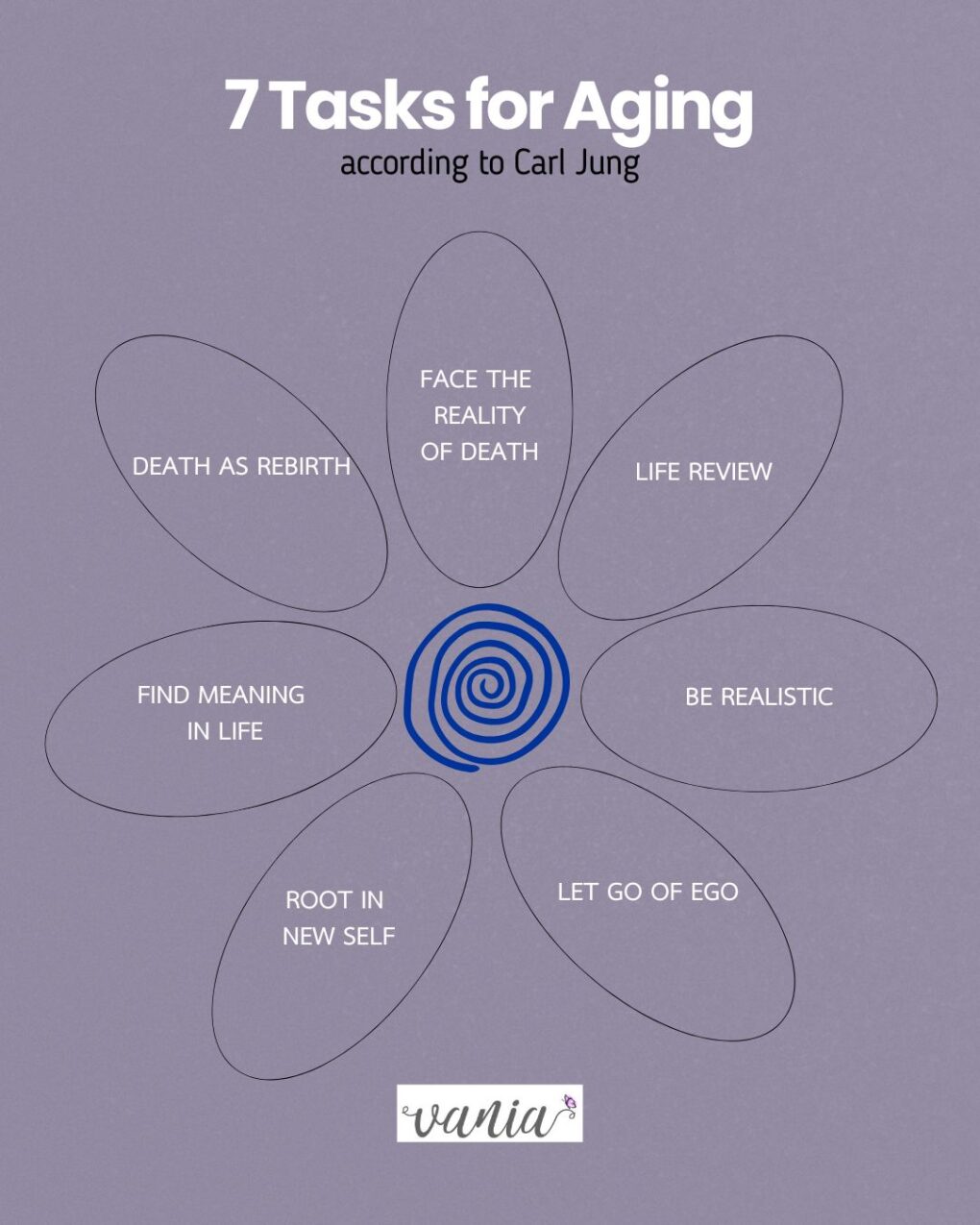
In Carl Jung’s body of work, he shares tasks of aging. I love the consciousness that comes with stepping into this role with integrity and intention. I chatted with a dear friend about this and we got curious about the elders we want to be someday. I’m nowhere near ready to be a crone as I’m just now finding my footing in my virgin/queen era. To be an elder is a privilege that most older adults don’t get. To be seen as wise when i am a 75 woman is the biggest accomplishment and achievement for me. And not for the work i do and the success from that. Rather, it is from a life fully lived, and to have people sit at my fit and ask for my life story; that will be such a gift and honour. And yet being wise is embodying my knowledge in putting it into action and so this is one way that I am tested with apprenticing with becoming an elder someday. If I am so lucky to be one, I will do it with a badge of honour: That means I need to do it with joy over despair, love over being negative.

Our grief phobic and illiterate overculture is afraid to face the reality of aging and death. When we accept this inevitable ending, it offers us an opportunity. How we choose to begin to face the reality of this is the key to unlocking this door that stands at the crossroads.

We are never “old” old because in each new moment you are new. It is in this newness that i seek to explore more in my work. The nature of circling back to myself and my life already lived is a practice of remembering what younger versions of me wanted, and being able to fulfil those dreams now because I also want them still AND can birth them. And it’s having that wisdom to know how to apply all i have learned along the way. When we take time to sit with who we are becoming, and what we hope for our life – this allows space for sovereignty and agency.

A Well of Grief

We are a month into this new year, and there is so much to grieve already. The human rights of folks in various parts of the world, the right we have to democracy and our own voice, the humanity of it all actually meaning something.

With a new calendar year, we are offered a practice to honour this shift as a rite of passage. Rites of passage are pivotal moments that mark our life in stages and phases. They follow an arc of separation from who we were, to the liminal space of transitioning into a new identity, and then integration of this role into who we are overall. What these passages also include is grief that is hidden in the shadows. Grief for what is ending, even if we want it to, let alone what has been taken from us.

It is important, then, to start the rites of passage by taking time to be with the ending and accompanying grief so that we are not carrying this heaviness throughout our journey.

Whenever i am faced with this tension in my heart, i give myself the healing balm of nature. Not just to escape (though i am being called more and more to run to the woods), but to also glean the wisdom of nature. Mother Nature tells me that there is up and down, back and forth, death and rebirth. The snow that fell in record numbers is a testament to our climate crisis, and also the snowflakes are so beautiful. It is all about balancing this tension of opposites.

“Snowflakes are one of nature’s most fragile things, but just look what they can do when they stick together.” ~ Vesta M. Kelly

One of these tensions is the balance of new beginnings that come from endings. We need to honour what is ending, whether we welcome the end (like to winter) or not.

We don’t just grieve for what we had that’s now gone or what we wish we had and didn’t get. We also now have a moment to be able to grieve who wasn’t able to grieve in their lifetime. We grieve for them, not just about them.

Grief is the testament of the love we have for what is now gone.

Grief lives alongside the happy moments as it is the bridge to this happy experience coming to a natural end. That can be the last day of school at the school that has been in your family’s life for 13 years, the last time you take your kid for ice cream on the last day of school, the last time they held your hand.

Grief asks a lot of us. But it also gives. In time, it reveals the quiet wisdom of what mattered, what changed us, and what still lives within. You don’t have to rush your healing. Your heart knows how to find its way.

Letting go doesn’t mean loss necessarily. It means accepting that growth and change are inevitable. That a rite of passage is the process of grief for what is ending all the way to the incorporation of what is new. We need to be glad for hte hand holding and cuddles for what they offered and created, adn that the love we offered is what will be repeated in our children as they pass the baton.

We can’t think our way through grief, we can only feel it. We feel it in our lungs, or in heartbreak. It feels like a messy ball of yarn that is messy, and full of knots. The only way to clean it up is to tend to it directly.

That’s where the love meets the grief.

Gates of Grief
In his book, The Wild Edge of Sorrow, Francis Weller shares this: “The only way out is through and the only way through is together.” It is not about the journey or the destination but the company you are with when you are journeying through grief. We are not meant do it alone.
1. All that we love we will lose (Francis Weller)
2. The places that did not receive love (Francis Weller)
3. The sorrows of the world (Francis Weller)
4. What we expected but did not receive (Francis Weller)
5. Ancestral grief (Francis Weller)
Optional extra Gates of Grief:
6. Trauma (Francis Weller’s optional gate)
7. The harm I have caused to myself and others (Sophy Banks)
8. Anticipatory grief – fear of what is to come (Sarah Pletts)

“We have entered a prolonged season of descent, taking us down into the unknown. In the imagery of myth and fairy tales, we have left the ordinary world and have entered the underworld, a sightless terrain that is shadowy and strange. I have come to call this time of descent The Long Dark. It may be decades or more likely a few generations before we see the farther shore of this crisis, if we make it. I say this not with a note of despair, or with an attitude of hopelessness, but, instead, recognizing and valuing the necessary work that takes place in the dark. It is the realm of soul—of whispers and dreams, mystery and imagination, death and ancestors. It is an essential territory, both inevitable and required, offering a form of soul gestation that may gradually give shape to our deeper lives, personally and communally. Certain things can happen only in this grotto of darkness. Think of the wild network of roots and microbes, mycelium, and minerals, making possible all that we see in the day world, or the extensive networks within our own bodies, bringing blood, nutrients, oxygen, and thought to our corporeal lives. All of it happening in the darkness.

The requirements for this time are not the familiar ones of achievement and growth, clarity and power. No, this season is asking for a new rhythm, one that is more attuned to humility and listening, stillness and rest. I hope each of you finds little pockets of refuge that support your intimacy with soul.” — Francis Weller

How did his words land for you? Do they resonate deep in your bones like they offer me?

Grief work is subversive cultural shadow work because it is committed to acknowledging death in an individual and collective way. We spend so much time bypassing it in our spiritually starving overculture, and focus on love and light without also realizing integrating our shadow is what completes us. Western society has become grief illiterate, as we become more individualistic and severed from our emotions and lineages. We all need to apprentice with Grief and find meaning in the loss – not of the loss of our beloved, but rather for what our life is now that they are gone. This is a task of mourning and we are not meant to do it alone, we in fact need community to witness it and hold us.

The Four Tasks of Mourning by William Worden
Task 1: Accept the reality of the loss.
Your mind can know long before your body accepts it.
Task 2: Feel the pain of the grief.
Your job isn’t to be strong. It’s to stay with yourself through what hurts.
Task 3: Adjust to a world without them.
Emotionally, physically, spiritually. Everything shifts.
Task 4: Find an enduring connection with them while building a life around the loss. It is not about moving on, but rather moving with.

When we turn ourselves off from our sorrow, we become stuck and loose our flow state. This represses all our feelings as a consequence, including our joy. We need to be tender with ourselves. There will be big waves of grief that feel like they just burst from us, or quiet waves that are an ever-present current. Knowing what you need in a given moment is key, be it a distraction to get through or a soothing resource.

The pain you feel is the sensation of unexpressed grief.

One thing that may help is placing your feet on the ground and saying “I am the shore, and my feelings are the waves that come and go.” Feel your feet as anchors. Let your feeling come and go, and let it be felt. We can’t distract or bypass them forever, we have to move through them.

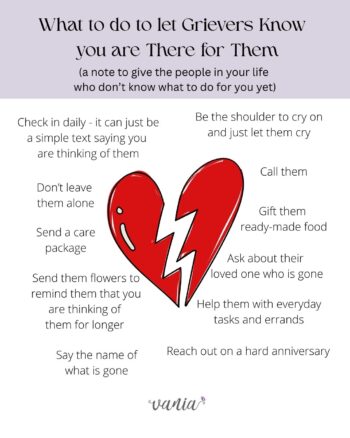
And while we can resource ourselves, we are not meant to weather this storm alone. Well-intentioned family and friends alike struggle to be the calm shore for grievers. It is partly due to their lack of personal experience, and also how grief and loss is tethered to the shadows of our humanity. Regardless, endings are inevitable, our sorrow doesn’t have to be.

If you’re moving through loss, I hope that your community offers a small anchor, not to fix anything, but to help you feel the strength that’s already here.

And if they aren’t showing up for you, yet, send them is message with these simple yet profound suggestions.

A Year with Presence

Each year, i choose a word to lead me, to teach and guide me. This year, i was given the gift of PRESENCE, and like many words before, i end my date with my word with so much gratitude and awe of this practice. It was the perfect word to be in communion with: I had noticed too much time on my phone, watching other people live their life, and struggled with healing my core wound of belonging. In spending time with my feelings and thoughts in 2024, I realized that i inherited a legacy burden (or i like to call it an ancestral wound) of loneliness. So, presence with my feeling lead to a year of pushing myself to be more present in my life and world.

I always use the spiral path of attuning to myself through a mind body and soul frame of reference. So this year, i sat with my mind by practicing Mindfulness. I sat with my heart so i could find where my Self lived, and not just the Parts who run my inner show. True presence is being in Self energy, so that we’re not fighting ourselves or our parts, but rather being our true full selves. I found my presence lives at my heart centre and this lead to a deeper communion with my soul: I became present with my soul seed and glimmers of the divine. This intentional action helped me embody a loving presence towards myself, fuelled by curiosity, attention, and being enchanted with life in the present moment.

“When you are present the world is truly alive.” Natalie Goldberg

Presence is a healing reparation and as a therapist i trust that my loving, attuned presence in a session is part of my medicine. For many, we don’t have access to another human who truly listens and holds space with full rapt attention. This can bleed into an attachment rupture, so therapists can offer a repair with their undivided attention. Presence facilitates a new depth of possibility of interpretation of a story and thoughts by instead allowing ourselves to be guided by what is right here, right now. It is a fully embodied and immersive experience that only thinking about gets part of the way in and down. In Toxic Productivity by Israa Nasir, she shares that “healing takes place when you develop curiosity, consciously look inward, reflect on the way you think, feel and act, and then make other choices to change how you think, feel and act.” As a somatic therapist, listening to the soft cues and calls of the body is what allows for full healing and transformation. We listen with our eyes and ears. I think of this addition as a necessary ingredient for alchemizing healing – we need more than content and understanding, but also processing that can lead to a more sustainable change. Otherwise, the gold tarnishes and turns to rust, and the spiral remains a loop.

Attention to Detail
Presence offers
the seed to grow, the spark to light.
It allows for
attention to this moment
like the gift it is.

We we can invite
our mind to quiet,
our body to soften,
our Soul self says thank-you.

May this moment
right here,
now.
Hold you with
curiosity and awe
as you turn inward
and find your inner fire.
~ vania sukola

Presence is giving ourselves permission to be fully alive in this moment, right here right now. It allows space for the feeling that is also present, and also temporary. Giving myself attunement through my own presence helps me access what i need, wish for, or desire. It slows down urgency and hustle culture, as well as internalized patriarchy because it ultimately guides me to check in with my needs and attend to them. And so, presence became the catalyst to reclaiming the right to have needs, and more so to follow through with tending to them.

Like everything, presence needs practice, and not perfection, to integrate it into your life. In The Witch’s Way Home, Emma Griffin shares that being presence with the present moment is a way to deepen your intuition as well as break free of constraints enforced by patriarchy. The pause that is required helps us tune into our surroundings, and trust that there is no such thing as coincidence. We need to be present to notice the synchronicities, the repeat of numbers or birds, the song that keeps playing. This journey with presence enabled me to find a few practices to help me land more fully in my own presence.

Stop Breathe Be – pause exhale be body
This year, i had a relationship with cold plunging and strength training. They both offered a practice of presence – to not rush through the steps but to be present with my body and breath through them. It was my body who told me when to get out of the cold water, not my mind. It was my body that told me i could go one more round. A simple yet profound way to get into presence is to just spend a few moments listening to your own breath. Where does it start, where does it travel to? Start be having a commitment to your own breath for a minute. What is the quality of your breath? Does it seem to be saying something to you?

Orienting to the Space
Orienting is a popular somatic practice, and for good reason. This practice helps us land more fully in our body, especially when in a new place or we need to drop into our body after spending too much time in our head. It builds on the concept of Interoception, a way of looking inward and witnessing our own internal landscape. Look around your space – what do you see? Spend a few breaths taking in an item, an image, a sound, or a smell. Then let this item infuse into your body as a way to drop into presence. The body enters a state of calm presence when we have a felt sense of safety, trust, belonging, and connection with our surroundings.

A Date with Your Journal
Amy Cuddy shares in her aptly named book Presence this: “Presence is the state of being attuned to and able to comfortably express our true thoughts, feelings, values and potential.” She continues to share that “it’s a moment-to-moment phenomenon.” Our thoughts have a way of running ahead of us, and causing us to claim what we feel or think is 100% true. It might be, or it might be a part who gets activated by a certain emotion. Journalling as a way to process an experience can help us be self-reflective and more curiosity allows for more Self-awareness. A great journal prompt is this writing shuttle: “Today, what captured my attention was….”

Turn-off Distractions
The presence of my own heart’s desire can lead to bliss. My present mind is a way to shift my experience so we need our full attention. In Tantra-related research studies found that the #1 thing women need during sex is the partner’s presence – just being there, having all the time in the world, and to offer touch without expectations or doing much. Deep attention births connection and aliveness, and this is ultimately what leads to a more fulfilling experience and relationship. And surely, why do we need to rush a good thing, and one that is so delicious and pleasure-filled? As Glow Moments give us deep presence and glimmers are the micro gifts of delight, maybe there is a reason we need to turn towards the alchemical change that is offered via pleasure, beauty, and joy.

Have a Single Focus
One book i read this year was The Relaxed Woman by Nicola Jane Hobbs. Her book spoke about the impact of capitalism and internalized patriarchy as a way to make us override our rest. It shared how multi-tasking not only burns us out, but also can make us take LONGER to get things down. I love her concept of Safeness Signals. These are things that create the somatic experience of comfort, calm, and connection. They can be via social events that are soothing, or nonsocial individual experiences that amplify our senses and spiritual self. For instance, presence with a loved one, a favourite meal, music, or rose oil are my “Safeness Anchors” as they ground me in the present moment, as well as connect the pace of my heart to the moment right here right now.

Mindful Movement
Nothing is inherently self-regulation. Even if it is with my own breath, i am co-regulating parts of my body and self. When we mindfully attune to our body, we become even more present with what it is trying to tell is, what information it is offering. This is where wisdom and insight can inspire change. Learning about polyvagal theory, the Window of Tolerance (i love the updated term Window of Presence!), and the nervous system has revolutionized my life. It has healed my attachment style and fostered a secure sense of Self as well as confidence. Dancing, bike riding in the city, and being in ceremony with other people, plants, and nature has been the reclamation and remembrance i needed. Doing this work has also offered a deeper decolonizing reframe about healing work, as i know our ancestors carried this wisdom already.

Full Connection
Our social engagement system has an important role in promoting our overall health and well-being. Spend time with others who give you attention. Be it a pet, a friend, a lover, or your child. It is not just about being physically present. Rather, we need to have our hearts co-regulate, have the gift of mirror neurons and shared experience. Marion Woodman has been teaching me about my soul and deepening into presence with the oracular wisdom of my womb and dreams this year. In soul-making school with Sil Read this year, one phrase we said at the beginning of each class anchors us: “If we could allow the pace of our meeting to meet the pace of our heart, that is where we will find genuine understanding.” It is the word genuine that has been such a teacher for me this year. It is what helped me shift from a distracted presence or Part to one that is truly self-led. This is what allowed me to feel more belonging – to myself and also as a way to heal my core belonging wound and experience of loneliness.

Commune with Nature
Nature inspires. It wants us to revel in its beauty with awe and wonder. It is not just what we can receive from it, but rather how to be in communion with it. One of the biggest gifts this year has been the spiritual and sacred way i have been held in ceremony with and in nature. I made a commitment to myself to attend women’s festivals and weekend retreats this year, as a guest and ceremonialist both. Some were intentionally held in places out of the city, while others were circles close to my own urban dwelling. All fused the elements and nature’s offerings into them as part of the experience. Being able to sit under my Sacred Tree, offering her gifts and gratitude has been a beautiful way to shift the mundane daily life into one with more presence with spirt.

Presence is an anchor: Giving myself presence is like rooting myself in the sand after landing at the bottom of the sea. If offers a felt sense of sure-footedness in my body and mind. It births a version of us that is connected to ourselves and outside our own self, as well as grounds us with confidence and calmness in our body. When we strive towards aligning with our most Self self, we send out an energy and frequency that is deeper than our intellect. Rather, our soul self is alive in the moment and we are channeling a level of vibration that reflects our truest self, not just the parts of us that have been created to protect us. We are living in a more conscious way, awake to each moment with intention and integrity.

This year, i ultimately learned that i love my own company, and solitude is not the same as lonely. I can be in a group of people and feel so alone. It is in a community with soul kin and mirror friends when i know my presence is valued and wanted. This is where the work of finding our true Self is needed. This presence creates a radiance of Self that is both connected and grounded. It is a frequency we send when we are aligned with our essence, in the present moment, and is key to creating connected, conscious relationships with ourselves and others. With presence, we are awake in every moment, present in our body, and able to access our inner wisdom. When we take time to get to know our truest self, we are gifted with being present by it, and the people who are lucky to be in our company get to know this version too.

The Unravelling that Transforms: To Be Heard is to Become Me

It took me suffering in silence because I didn’t realize that I had a poison ivy infection for me to realize that I too, like my mom, don’t always speak up about things happening to me if it might be an inconvenience for someone else.

I was itchy and scratching for days, and when i noticed the tell-tale welts form on my legs, i kept them a secret. I kept this to myself because i thought the pain would go away on its own, and that i didn’t want to be a bother. I didn’t want to be a burden. It was then i realized i had started saying the same thing to myself about myself that my mom had said to me.

And this is not something i want to continue.

I reached this new place of understanding that venting or being able to talk to someone about my problems doesn’t mean I know how to fix them or even that fixing them is possible. It’s when I talk about my life that I’m showing up authentically and not abandoning my own self.

Gabor Mate shares about the importance of authenticity and attachment. I recently saw a clip where he spoke about the way that women die by not getting their needs met. He was talking about how when we keep our needs close and don’t share them, we’re not being authentic to ourselves. Even if it means that we may not be answered or get support, just by sharing what our needs are or what’s on our mind can also be very helpful.

My mom died by not getting her needs met. She had been mentioning having stomach aches and eventually knew that she needed to go to the hospital because this pain wasn’t normal. She died about 10 days later because her body shut down. She went in thinking she had a stomach ache and minimized the possible reasons for this pain. She never left that hospital and died of undiagnosed ovarian cancer.

I don’t want my mom’s death to be in vain nor do I want it to be her legacy. And so, being able to advocate for myself and listen to other people’s stories has become one way that I’m of service in this world. In honour of my mom and the life that was just out of her reach, I am also committing to live my life fully. Bringing pleasure in an embodied way is an even more healing way to repair my ancestral story.

“If we could allow the pace of our meetings to slow down to the pace of our hearts, we might find genuine understanding.” ~ Marion Woodman


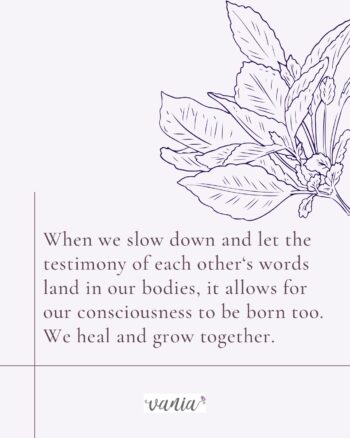
When we slow down, and really listen to each other, someone’s story or testimony can also be our medicine and healing. We are brought to tears when we hear someone else’s story. Not just because it resonates for us in our own life, but also because what they’re saying makes us feel so much love and care for them … and when we are the ones that are sharing and see tears in others eyes, what feels so delicious is that they are sending me love and holding space for me instead of just waiting for their turn.

So often the silence that we are giving someone is actually us just thinking about what we are going to say when it’s our turn. What about if we Listen fully with our heart? What if we see fully with our heart so that we can be transformed by someone’s story and not just have a listening turn for them.

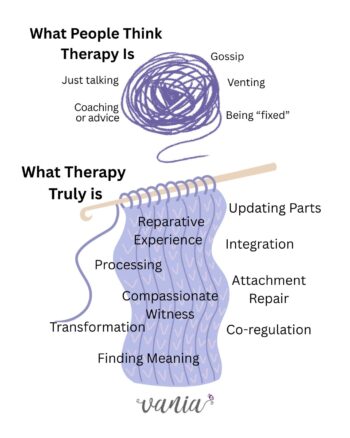
Is therapy a bandaid solution to building a village? I don’t think so necessarily. There is attunement that happens when we hear each other, see each other, and are with each other with our full bodies. Even if it’s through a screen, it’s with our full presence.Healing can be processing buried memories and feelings through movement, having practices to help us better understand ourselves, learning how to nurture our self back together, repairing our childhood experience through the body, unpacking trauma that we experienced, finding meaning and clarity, new insights and understanding, and give ourselves new ways to help us let go of our inhibition.

This is also why I feel so honoured when people share their stories with me – “talk therapy” should not be so underestimated and pushed aside. It’s when we share our stories with each other that we feel connection: When we speak out loud the stories that we have been taught to be silent about, it changes the inner landscape of our being. Our needs, dreams, thoughts and feelings deserve to be heard and witnessed. We are weaving a new thread together, untangling a ball of thoughts and feelings, and creating something altogether new like a new tapestry or cosy blanket. Therapists serve as a guide to help weave the unfolding.

Going to therapy is like giving birth to a new version of yourself and the therapist plays the role of beign a life midwife or feeling doula

When we are moved by each other, this is part of this collective healing work that needs to happen: We are not just individuals in our own healing, but also healing together. I think this is a big part of why being in community, in circle, in a caring container is so necessary because when we are together, we heal together.

Talk is one way to connect and it can deepen healing. It is not surface level, especially when we get out of the loop that is stuck in our head. What we say is a spell and can transform. There is magic in our words. It is also a physiological change: sharing what is alive in our emotional body creates oxytocin to be released. This hormone is associated with love and connection and is the remedy against stress hormones like cortisol. This hormonal shift is what decreases stress because it regulates our nervous system. Our body is hardwired for connection, so we are social creatures like bees or wolves.

We also know that the vagus nerve is activated in the throat area, which is why humming, singing, or buzzing like a bee are self-soothing practices to alleviate stress. Talking then, so too serves a similar purpose. It is not just talking for the sake of it but also feeling held, seen and heard. This is what enhances co-regulation and an ultimate shift in our nervous systems and emotional regulation.

I’m kind of getting to a breaking point around how many people, especially other care practitioners who call themselves healers or somatic coaches give therapy a bad rap. I think they might have been speaking from their own wounds or negative experience surely because what happens in the sessions I offer for is more than the silent listener. Rather, it’s a deeply intuitive a tuned relational alchemy that brings in ceremony as much as it brings in cognitive reframing. Therapy is the guided unravelling of stuckness that transforms into something beautiful – our healed Self.

I am humbled to share that this Winter, i have been a therapist for twenty years, and the last 10 years has been in my thriving private practice. I always knew i wanted to be a therapist, it was my calling and also a role i get to practice at an early age.

Another form of transforming with words is poetry. As someone who has turned to poems as a comfort and support, writing them help me process feelings that feel stuck in me, with half sentences coming out in bursts. I recently wrote a poem that brought voice to my eldest story origin story. It was inspired by a certain pop sensation, who may have gotten some of the themes around the eldest daughter wrong. I am the eldest daughter of an eldest daughter and am really resonating with this archetype of the plight of the eldest daughter.

To Become the Eldest Daughter
To be the eldest daughter of the eldest daughter line
is a dance with fate.

Maybe I became a therapist because
it was always meant to be.

Maybe it was the early days of holding space for
my mom‘s secrets and stories, her pain and processing.

Perfection was the strongest protector.
It was in all the straight A’s
and pretty dresses, the ballet lessons,
and tiny doll sets.

It was knowing how to attune to
the slightest of shifts, whether it was
how a door was closed or the way
the kitchen spoon hit the floor.

To be the eldest daughter is to be given
this contract without ever being asked.

Taking time to sit with my inner child
and the teen I became let’s them know
I can take it from here.

I am a daughter and I am more than that.
I have a whole basket full of
my own wildest dreams.

To become the eldest daughter is to heal
and find my own place called home.
~ vania sukola

Thank-you for listening to my story.